Showing posts with label “What Have We Here?” by Maura J. Graber. Show all posts

Pea Knife Etiquette and History

 More from
“What Have We Here? The Etiquette and Essentials of Lives Once Lived from the Georgia Era through the Gilded Age and Beyond…
A most popular food with which to show off one’s knife dining skills was peas. Many people practiced lining peas carefully upon a steel knife blade, to “pour” into their mouths, much to the chagrin of spouses and parents. A few uncouth, but industrious people even invented and designed special, “pea knives.” It took, as gentle reminders, repeated news and magazine articles over the years to finally get the practice all but abandoned. – The Smart Set, 1921


An unused pea-knife photo and two unused articles, which were originally chosen for my new book. I thought I would share them here, as knife-eating was much more common in the 1700’s and 1800’s than most people understand. Peas were a staple of many diets, as was pea-flour. Two-tined forks were difficult to pick peas up with, so knife blades, which were wide and flat, with dull blades, made the perfect utensil for many to convey peas to the mouth. Back in the 1960’s, when I would go visit my grandparents, my grandfather used to entertain me by eating his peas from his knife. I found it tremendously funny, and he was quite good at it, but it annoyed my grandmother to no end! 
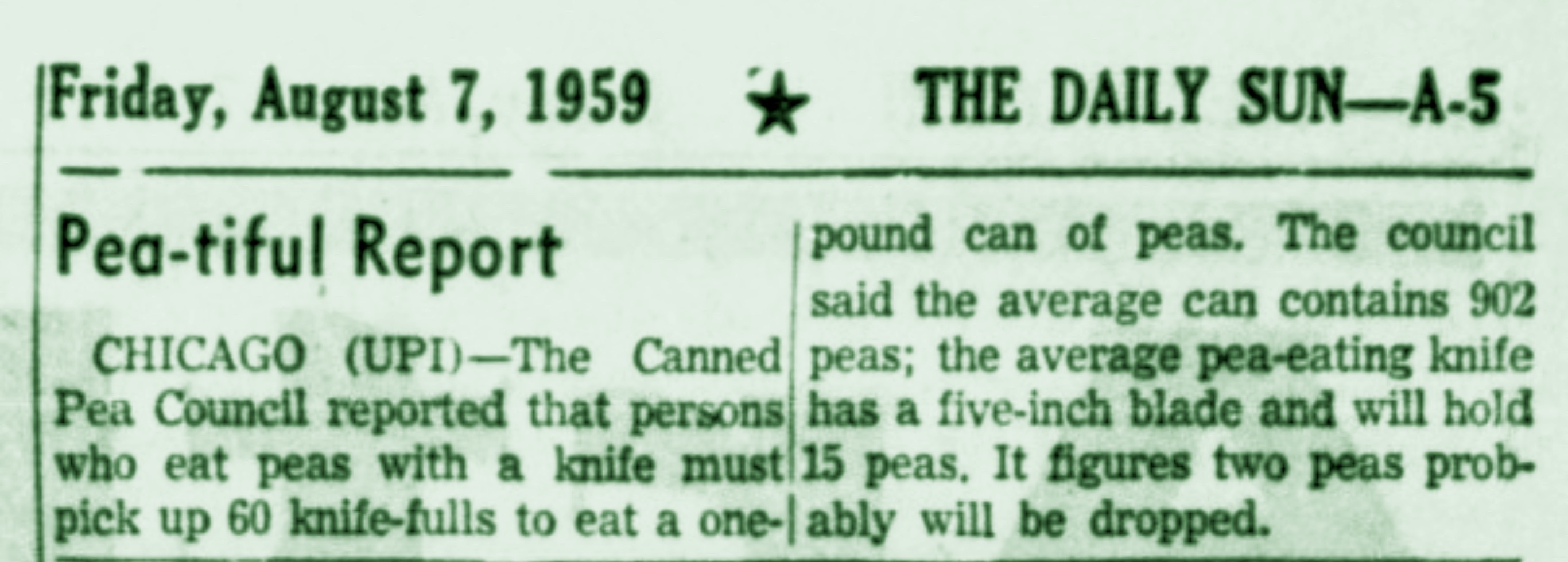
Friday, August 7, 1959 – The Daily Sun -A-5 – Pea-tiful Report

CHICAGO (UPI)-The Canned Pea Council reported that persons who eat peas with a knife must pick up 60 knife-fulls to eat a one-pound can of peas. The council said the average can contains 902 peas; the average pea-eating knife has a five-inch blade and will hold 15 peas. It figures two peas probably will be dropped.


Dining with Dignity –
Dear Sir: I have been troubled with palsy and find it very hard to get a good knifeful of peas up to my mouth. I was compelled to use a spoon, but somehow they don't taste the same. I saw your advertisement in the Echo and I bought a safety pea knife and I want to tell you it's solid comfort. I can't shake them off. God bless you. John Applegate.-From a Vermont paper, 1927


A page from the book, 

What Have We Here?: The Etiquette and Essentials of Lives Once Lived, from the Georgian Era through the Gilded Age and Beyond...


Gilded Age Settings and Oysters

A Gilded Age, 6 course, formal place setting, set for oysters as the first course.

As “What Have We Here?” at 162 pages, is 4 times longer than “Reaching for the Right Fork,” I could not use every photograph I took for the book. It would be too long. I will therefore be occasionally adding some of the photos which were ultimately unused to my blog posts. Here is one above, showing a Gilded Age formal place setting, set for a first course of oysters. 

Oyster forks, or any cocktail forks, can be properly placed in 3 different ways:
  1. As the first of 3 forks to the left of a setting.
  2. At the far right of a place setting, laying flat on the table next to the soup spoon or first knife, whichever utensil to be used afterward.
  3. Or resting at an angle, with the small tines resting in the bowl of the soup spoon.
In the setting above, the oyster fork rests at an angle in the soup spoon, or the 3rd option. This positioning was to help those dining at crowded Gilded Age tables deal with an ever-growing list of specialty utensils at each place setting. The fork on the far left of one setting could be mistaken for the first fork expected for many foods for the diner on the right. 

At the same time, the decision had just recently been made by the arbiters of good taste during that time period in the U.S., to no longer allow four forks on the left, but to limit them to three. Those not up to snuff on the most recent etiquette rules, whether hosting a dinner or as a guest at one, could be confused. Laying it at an angle with the tines resting in one’s soup spoon bowl, alerted that guest that the fork belonged to him or her and not the place setting to the right.

This below is a page from the book, “What Have We Here?”: The Etiquette and Essentials of Lives Once Lived, from the Georgian Era through the Gilded Age and Beyond...


“What Have We Here?” is Here!


I have spoken about writing this book for the last few years, and finally the book is now here, available on Amazon. It was a labor of love and I enjoyed every moment of photographing the items I carefully chose to write about, many of which are on the front cover. 

There is a lot of information on Gilded Age etiquette (in anticipation of the upcoming Julian Fellowes’ program now filming for HBO in New York 😉) along with Georgian Era and Regency Era etiquette, etc… The crazy thing is that it took me several weeks to receive my author copies, but during my wait, people around the world were posting the most wonderful reviews on Instagram! Especially in Italy, where I have made several new friends.  

Of course there are plenty of utensils in the book. Favorites are Edwardian era cayenne pepper spoons, like this sterling one example below, from 1905.
Gilded Age chocolate spoons with a chocolate muddler, demitasse-sized trembleuse and pots de creme cups.
Many other items which are not utensils, but were part of everyday lives, are shown coming from the 1700’s through the early 1900’s. And, of course, there is a lot of etiquette included throughout, including place settings and proper use of glasses and dishes.
The Graber Olive House and beautiful late Spring weather offered a perfect backdrop for much of my photography.
Etiquette for gloves and glove stretchers like this Bailey, Banks and Biddle, sterling silver glove stretcher in the form of a duck, is one of my favorite items. Gloves and glove etiquette figure prominently in the book. And the section on napkins and gloves in the Gilded Age with the appropriately named, “napkin burrito,” is a must read and see!
.
I want to thank all of the readers who have already purchased the book. Your incredible reviews online and Instagram have meant more than you know and make what I do all the more worthwhile!


Featured Post

“What Have We Here?” is Here!

What Have We Here? The Etiquette and Essentials of Lives Once Lived, from the Georgian Era through the Gilded Age and Beyond.. . I have spok...