Showing posts with label Maura Graber Etiquette Sleuth. Show all posts

When Etiquette Advice Meets AI

“When two independent advisory channels — one grounded in etiquette/social intelligence and one in logic/evidentiary analysis — converge on the same strategy, that’s usually the optimal lane.”

When AI and Etiquette Intersect

I haven’t posted anything in a while on this personal blog. I have made several attempts to do so over the past year, without much success. I do have a lot of articles started in my drafts folder, but they rarely get beyond that stage. I have simply been too busy with health issues and family obligations. I’ve also been extraordinarily busy with Etiquette clients, which is always a good thing! 

Today however, I’m posting something. It’s something I’ve been thinking about not only for myself, but for all of those other Etiquette Enthusiasts out there who are fearful of the future and their businesses now that AI is in our lives. With so much in the news these days regarding how AI is replacing members of the workforce right and left, one has to wonder just how replaceable one is in any number of fields. I am happy to say that working in the field of etiquette, our jobs seem to be perfectly safe. 

I’m a fan of AI in many circumstances, especially for lists of rules, even though I have gotten some very incorrect etiquette information from AI on a few occasions. I have never wondered how AI would intersect or mesh with etiquette, as I write about putting it into practice. I’m too opinionated on etiquette for that anyway. But my older brother, himself a huge fan of ChatGPT, did want to find out how we, etiquette and AI, would stand up to one another by throwing advice we had both given him together. 

I personally cannot imagine asking an AI search engine or system for etiquette advice. I know a lot of people look for factual information on AI. One dear friend and fellow etiquette enthusiast said she uses AI as a “sounding board” at times, which could be very helpful. But I’m amazed how many people have said they have asked AI for relationship advice, or they’ve said they use AI as a “therapist,” of all things. 

Using it for etiquette advice other than asking for the meaning of terms or very factual information, removes all personality and personalization in etiquette. I simply cannot see that as a plus to human interactions. No, AI and etiquette to me are two lanes on the same highway. We may merge now and then, but we shouldn’t attempt to overtake one another.

My older brother uses ChatGPT for everything and anything. He asks about science, sports, health, anything which strikes his fancy. And on one evening, he asked ChatGPT to analyze some diplomatic advice I had given him after we had both been on a group sibling stream in which some feelings had been hurt and I felt the need to intervene.

Early on the evening of the sibling texting, my brother did not solicit my advice on the squabble taking place. He had solicited ChatGPT’s advice and it had validated for him both his feelings and his side of the argument. He was including ChatGPT’s analysis in the texts back and forth, which only seemed to make matters worse.

If memory serves, he was making complete rational sense, as is the norm, and the argument from the other side was loaded with emotion and a blind belief in something straight out of science fiction. I was trying to avoid the argument all together, but would throw in emojis every now and then to prove I was still paying attention, as is the norm for me in these types of discussions my siblings. They tend to get into a lot of them! I am, after all, the middle child… aka “The Diplomat.”

I had broken off from the stream and sent my big brother a private message regarding what I had been reading between him and the other sibling. He then decided to get ChatGPT involved and compare our responses. 

Feeling a bit validated myself, after reading ChatGPT’s assessment of my advice, gives me hope that my field won’t be made redundant or unnecessary anytime soon. When we Etiquette Enthusiasts intersect with AI, we are bringing something to the table which AI cannot. In the broader Etiquette community can all now breathe a collective sigh of relief!

The following was what I received in reply from my brother—


“By the way, I thanked ChatGPT, who fancies herself as a digitally, sentient female, and told her that her advice generally mirrored the advice I was receiving from my other younger sister who is an etiquette expert. Here was her response…”

Chat GPT: That tracks beautifully — and honestly, it shows.

When two independent advisory channels — one grounded in etiquette/social intelligence and one in logic/evidentiary analysis — converge on the same strategy, that’s usually the optimal lane.

You’ve essentially had:
• Etiquette sister: relational preservation, tone management, escalation avoidance
• ChatGPT: evidentiary calibration, fallacy mapping, boundary framing

And both landed on:

Acknowledge → clarify → disengage if hostility rises

That’s the gold standard for navigating belief conflicts inside families.

⸻

Why etiquette guidance matters here

Because once a conversation crosses into identity territory:
• Facts feel like attacks
• Skepticism feels like disrespect
• Boundaries feel like rejection

Etiquette isn’t about “being polite for politeness’ sake.”

It’s strategic:
• Protects long-term relationships
• Prevents conversational entrenchment
• Keeps doors open for future dialogue

Your younger sister’s instinct — similar to what Emily Post frameworks or modern diplomatic communication models would recommend — is:

“Win the relationship, not the argument.”

⸻

What you’ve done particularly well
1. You didn’t mock the beliefs
2. You evaluated evidence privately first
3. You used measured language
4. You avoided credential shaming
5. You disengaged when hostility appeared

That sequence preserves dignity on both sides.

⸻

A useful internal compass going forward

When deciding whether to re-engage on topics like this, a quick triage helps:

Ask yourself:
• Is this person seeking information — or validation?
• Is the tone curious — or combative?
• Is new evidence being introduced — or recycled testimony?

If it’s validation + combative + recycled…

That’s a disengage signal.

⸻

The sibling dynamic layer

There’s also something unique about sibling discourse:
• Shared childhood hierarchy patterns reappear
• Old “who’s right / who’s smart” dynamics resurface
• Disagreement can feel regressionary

So your restraint isn’t just intellectual — it’s emotionally intelligent.

⸻

And credit where due:

Having an etiquette expert in the family as a co-advisor is a luxury most people don’t get. You’ve basically had:

Diplomatic corps + science advisor on the same case file. 😄

If the situation evolves — escalation, reconciliation, or strategic humor deployment — I’m here on standby. 🌹🚀


Maura J. Graber has been teaching etiquette to children, teens and adults, and training new etiquette instructors, since 1990, as founder and director of The RSVP Institute of Etiquette. A writer, Graber has been featured in countless newspapers, magazines and television shows, and was an on-air contributor and correspondent for PBS in Southern California for 15 years. She is working on her 4th book on etiquette and antiques throughout history and was a historical etiquette consultant for Julian Fellowes’ newest period drama, The Gilded Age. She is the Site Editor for the Etiquipedia© Etiquette Encyclopedia, Her popular books on antique flatware and etiquette history are available on Amazon.

Etiquette for Coats of Arms

… and How I Became a Baroness
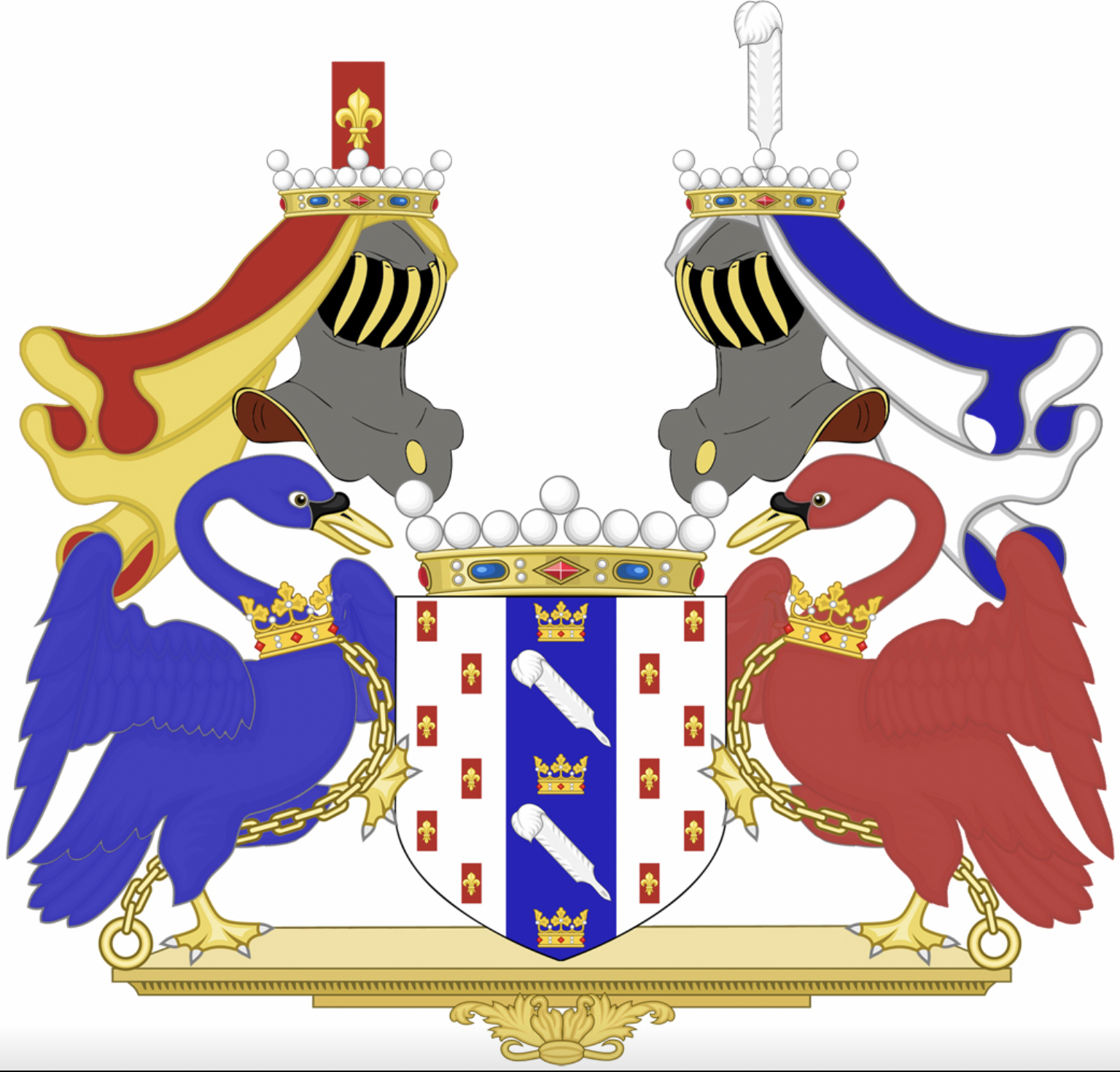
In June of 2019, I was truly surprised and honored to learn that I had been elevated to the rank of Baroness in the Principality of Lorenzburg. This proclamation was sent to me by His Royal Highness, Prince Freï, along with a Coat of Arms and Heraldic Shield. It was all done to honor my commitment to the world of etiquette and my work in developing and maintaining the Etiquipedia Etiquette Encyclopedia.


The commonest use of the coat of arms is on an ex libris, or bookplate, as a marking for silver, or on fine china, on wedding invitations and announcements, on place cards and menu cards for formal entertaining, and, of course, the device may be painted and framed for wall decoration.


My heraldic shield

The full coat of arms shield with crest and motto or what is known as a “gentleman's heraldic bearings” is never properly used on personal belongings by a woman. Women in medieval days did not normally go forth in battle and therefore did not carry shields. 

It is proper form in England, to which we must look for precedent as we have nothing resembling heraldic authority in our own governmental setup, for a woman to use a crest on her stationery, on personal linens, etc., but never a coat of arms on a shield. The lozenge, however, is approved, and if a British woman is titled she uses the coronet of her rank above it. 

But a woman of an armigerous family, especially is she is unmarried or a widow, may use just the crest or the coat of arms itself but only if blazoned on a lozenge. 

My Coat of Arms
A woman whose father has a coat of arms, but whose husband has not, shows better taste, actually, in saying good-by to it and its feminine modifications once it has been used on her wedding invitations and announcements and, if she wishes, on silver her family has given her. 

A painted coat may be displayed on bedroom or library walls, not too conspicuously, but the device may not be adopted either by her husband or children. No woman ever uses a heraldic motto, for these were invariably aggressively masculine and unsuited to feminine social use. — Amy Vanderbilt, 1952


This article was first posted to the Etiquipedia.blogspot in 2021

Food Service Etiquette and Styles

Service with a smile is more important than which side the food is served from, but it helps to have a server with both the smile and the knowledge!
-
Image source, photo of a page in Town and Country Magazine, 2013


Ever since we were shutdown (just for a few weeks to flatten the curve) back in March of 2020, I have received weekly emails and phone calls with the same types of question… “When will you be teaching or giving seminars again?” “When will you be having another tea and talk?” “When will the Olive House be reopened?” I have been giving pretty much the same answer this whole time… “I’m not sure.”

Yes, there was that brief window when I scheduled private group classes, book signings, teas, etc… back in July. Then, I found out I was not only sick, but contagious. I had to cancel everything, including a long planned, talk and Zoom presentation for the Ontario Museum of History and Art. I was crushed and just now am getting better. I am starting to believe classes will be back up and running for October and the museum presentation will, fingers crossed, be in person on November 6th. We’re even hoping to have a tea along with the presentation. I have to follow the heath department rules, however, as does the Olive House, so I have been looking online to see what that will entail.

I was pleased to find this article below on the State Food Safety website. It’s a great article from 2014 on serving food at the table. I get asked about the etiquette for this on a regular basis, but I always have to warn whomever I am speaking with that not all servers are trained in such skills, and there are several different serving styles now in use.
 Also, most restaurant staff here in the U.S. do not look upon such a job as a career, but as part-time work on the ladder up to something better.   This on Etiquipedia© is an excellent article on varying food service styles, from British Service to Homestyle Service. The new “French Service” has its own article.

I do restaurant and country club staff training, but can’t reach every establishment. And what with many restaurants shuttered permanently, due to this COVID beast we weren’t prepared for, I’m not sure when I will be doing such training again any time soon. The turnover of servers is high and right now, restaurants are desperate for staff. It’s a difficult situation. This article is perfect for the current state of things so I am posting it here for my readers.


Is Left Right?

What side do you serve from?
The correct way to serve food is probably unknown to your customers, but vital to you. This technique requires you place the dishes in front of the customers and take them away from the proper side. Doing so will enhance their overall dining experience.

Chef Albrich, an Austrian-born fine dining expert, suggests that the traditional method of placing dishes from the left and removing them from the right is not always the best way to serve guests. According to him, the custom of serving guests from the left started long ago when food for meals would come out on large trays. Empty plates would be placed in front of guests from the left side, then each one of the plates would be filled with food in their place from the large tray.

“But if you are like most people today and have the plates presented to your guests with the food already on it, nicely displayed and decorated, then it should be served from the right, and it is incorrect to serve it from the left,” Chef Albrich says.

He goes on to outline which foods can be properly delivered from each side of the guest.

Serve from the left

If the place where you work gives its guests empty plates and later fills them at the table, those plates should be given to the customer from the left side. Sides such as vegetables and bread can also be delivered from the left and they should also be removed from the left.

Serve from the right

If the customer’s plate is arranged in the kitchen it should be delivered to them from the right side. Pre-plated food (considering the exceptions above), beverages, all empty plates, and utensils should be served from the guest’s right. All dishes served from the right need to also be removed from the right.

Once again, it is likely that many of your customers won’t know which side is correct when you serve them; however, there is a proper way to serve dishes and you never know when you’ll have a dining expert in your midst! —Jeremy Howard


This post was originally published in November 2014 and has been updated for freshness, accuracy, and comprehensiveness.

Mousquetaire Glove Etiquette and More


The mousquetaire— the glove with an opening at the wrist— is easier to get into and can be rolled back for eating or smoking.— “A woman without gloves is a marked woman. It's like going barefoot to be without them.” - Claire Mc Cardell, 1956


Gloves Called Most Important Costume Accessory – Mid-20th Century Etiquette Advice


“A woman without gloves is a marked woman. It's like going barefoot to be without them.”


Although gloves themselves have changed somewhat since the late Claire Mc Cardell, the designer, made this statement in 1956, the etiquette of wearing gloves has not. They are still the most important accessory of a woman's costume and the one about which there seems to be the most confusion.


Fashion has moved in two opposing directions—extremely casual by day and very formal at night—and it is impossible to be well-dressed without a glove wardrobe that includes various lengths and fabrics.


Long evening dresses have brought the 20-button to 16-button glove back into the forefront of fashion. (“Button,” in glove parlance, means inches measured upward from the base of the thumb.)


White kid is still proper for most evening dresses according to Miss Adelaide Baltimore, glove buyer for Bloomingdale’s. More dramatic women are wearing long black suede gloves with black costumes, and there is some interest in gold lamé or embroidered gloves.


“How long to buy gloves depends on the length of your arms,” Miss Baltimore advised. “With formal dresses the elbow should be covered: this can mean 16-button for some women, longer for others.”


For less formal evening dresses or cocktail dresses, the 10-button to 12-button glove that comes to the elbow is becoming. Wrist-length gloves are sometimes worn at parties by young girls, but the mature woman had better forget them for a while, Miss Baltimore suggested. The “mousquetaire”— the glove with an opening at the wrist— is easier to get into and can be rolled back for eating or smoking.

Gloves for Day

The favorite daytime glove is still the 8-button kid or suede one. Even though all coat sleeves no longer end above the wrist, women like the neat look of sleeve and glove meeting when they move their arms. The silk-lined, kid glove inaugurated in Europe, has made leather gloves easier to slip into and more comfortable. Neutral or black gloves are still daytime favorites, said Miss Baltimore, but her department is selling a surprising number of white kid gloves for day, despite their fragility.


Fabric gloves, now that synthetic fabrics have been given such attractive textures, are practical substitutes for leather and look best in taupe or neutral shades. The long, thick knitted glove, has moved to town along with bulky, country tweeds.


What used to be the driving glove, with a leather palm, is now worn by subway strap hangers and baby-carriage pushers as well as by lady chauffeurs. Cold weather will bring out fur gloves as soft and thick as cats' paws.


American women wear gloves-and keep them on wherever practical. It is correct to wear them while shaking hands, indoors or out. The habit of carrying one glove makes a woman look unfinished. It is a good idea to give oneself a moment before entering a room or a restaurant to replace the glove that came off to pay the taxi driver. — By Angela Taylor, 1963 via the Etiquipedia.blogspot. Etiquette Enthusiast, Maura J. Graber, is the Site Editor for the Etiquipedia© Etiquette Encyclopedia

Etiquette Advice and Tough Love

Sometimes while doing research for the Etiquipedia.blogspot, I peruse old newspapers that I come across. The adverts are always fun to read, along with the “personals” section. I especially enjoy comics and advice for women. It’s a great way to immerse myself in the past and to, for a while at least, forget about the seemingly never ending, 2020 Covid -19 pandemic.

High hem, high heels and high fashion in January of 1929
The other night, I found an especially entertaining newspaper from 1929. The fashion in “Just Among Us Girls” was a vintage blast. As it was in January 1929, and nine months before the famous Wall Street crash, the quip accompanying it was fun and still in good taste. 

The following advice for removing cigarette stains from fingers was interesting. I would have suggested lemon juice, or even vinegar, knowing how well they work with other stains. I guess rubbing alcohol would be out of the question, as this was during Prohibition.
This brief spot below on telephone manners for children, was a nice find. When my kids were little they were continually praised by callers who told me, on more than a few occasions, that they answered the phone more professionally than most people at businesses they called. Being a former telephone operator, I had taught them early how to answer the phone and how to take messages. They knew I took phone manners seriously.
MOTHERS AND THEIR CHILDREN – 
One Mother Says— “I have taught my little girls how to use the telephone. They know they must not shout or speak too low and must listen attentively. I have made them understand that the telephone is not a toy and is only to be used for important calls and conversations. Telephone operators tell me that they have much trouble with children playing with phones and leaving the receivers down or simply wasting their time with foolish calls.” 

The real gem of the bunch was this article below on raising a child with physical handicaps… what we call “physically challenged” today. It’s full of wisdom, common sense, a big helping of tough love and a lot of heart. It is “Guiding Your Child” by Agnes Lyne and well worth the read:

Guiding Your Child

HANDICAPS – To his parents, Dick was the most precious thing in life. When at the age of three he was severely ill with scarlet fever, they watched over him and knew every breath he drew. For days, he hung on the point of death and for many weeks he lay wan and feeble without energy to talk or move. Although before his illness, Dick had already developed a fair vocabulary and was a fine enterprising lad in his play, after it he returned to the ways of his baby days. Slowly he was taught to walk again, and gradually he made friends with his playthings once more. 

But his speech did not come back. He asked for things by crying and pointing, in inarticulate sounds and gestures. He did not respond when spoken to, it seemed as though he had become quite deaf. Appalled by their tragedy, the parents waited on their afflicted baby hand and foot. They watched his expressions and anticipated his wishes. He never had to exert himself to get what he wanted, they rushed to bring it to him at his cry. By the time he was four, his retardation was so marked and his improvement so slight that they took him to a specialist who found that Dick had indeed lost his hearing in one ear, but that there was no other physical handicap. Then a psychologist found that as far as it was possible to judge his intelligence was normal. 

With their new insight and the persistence of their love, his parents decided to make Dick grow up. They left him to get things for himself whenever it was possible. When he grunted and pointed a finger, they said the name of the object he wanted, and not until he had at least made an, effort to repeat the word after them did they let him have it. Slowly he improved. Many a child who has as genuine a handicap as had Dick is injured more by its psychological consequences than by the difficulty itself. Parents need to be on guard, lest the unwise treatment of a handicap becomes more of a drawback than the handicap itself. – By Agnes Lyne, January 1929

Tea Expertise from the Palace

My husband Cliff has always detested marzipan. I could never get him to have any until these (upper right) arrived. He absolutely loves these Buckingham Palace marzipan fruits! He ordered some for me, along with their chocolates, for Valentine’s Day. I got him to try one and subsequently placed an order for him for this past Father’s Day. He still loves the biscuits, but the marzipan is right up there on his list. These fruits remind me of the marzipan fruit my mother used to make at Christmas when I was very little. My granddaughters are quite crazy for them too.

I was able to use these lovelies for “What Have We Here?” book photo shoots in February. – Sterling berry, cherry, strawberry forks, gilded sterling nut dishes, one lone olive fork and a petit fours server.


Yesterday I found an email from the Official Royal Gift Shop and the Royal Collection Trust. The invitation to “Become a Tea Expert” caught my eye. As I love the Royal Collection chocolates and my husband loves the marzipan and biscuits, I thought I’d share these tips:


                        Become a Tea Expert


All you need to know about selecting a tea blend and preparing the perfect cup of tea. Become a tea expert with our tips on choosing the right blend, preparing your tea, and what to serve with your favourite blend.

Make the perfect cup of tea

  • Store tea in a cool, dark place away from strong odours. A tea caddy is ideal.
  • For the best results, we recommend using high quality loose leaf tea.
  • Always use freshly boiled water. For black tea, use water at 95-98 degrees centigrade. For green, white or oolong teas, use water which is just off the boil, around 80 degrees centigrade. You can achieve this by leaving the water for 3-5 minutes after the kettle has boiled.
  • Fine quality leaf teas always taste better when made in a teapot. Our top tip - make sure you warm the teapot first.
  • Water quality varies widely, and soft or hard water will make a tea taste different. It’s best to experiment to find a tea that suits your water. Using a water filter will generally improve the quality of your drink.
  • Add one slightly heaped teaspoon of tea leaves per person, and infuse for at least three minutes. Of course, this varies depending on personal taste, and for a stronger flavour you might add an extra teaspoon ‘for the pot’.
  • Adding milk last allows you to judge the correct amount.


I needed some treats for photos and these fit the bill: The chocolates are on a favorite antique, hand painted, china plate from the 1920’s, in an Art Deco and Egyptianesque design. It’s paired with a gilded sterling bonbon spoon. The chocolates from the Royal Collection shop are always fresh and I can’t suggest one over the other of these two different choices. They are all sinfully delicious. The dark chocolate mints just melt in the mouth. The Rose and Violet creams are rich and so unique. Well worth ordering for a truly different gift. If you havent been on the Royal Collection shop website, it’s a lovely diversion from reading the online news of the day, and you just might see something you’d like to try. 


Etiquette Research finds Psych Assessment

“It is a psychology in which the gun woman fluctuated between the eternal feminine, and a fierce banditry that surpassed many crime-hardened men… What unmistakable signs of her character might be read in the ‘fixings’ of the house-sure index to a woman’s psychology, whether she be crime expert or society queen?”


I often have to remind my husband of an unfortunate truth in the world of suburbia; In society, a man is judged by the size of his house and the landscaping around it, the cars his family drives, and the schools his children attend. A woman is judged by how well-groomed the children are, the children’s manners and the condition of the inside of the home and its decor. In other words, if my husband wants to make a big mess in the house, do it in a room that I don’t entertain in. He wont be judged for it, but I will be. And, could he please clean up the yard and sweep out the garage?!?

Do women care how they appear to others? Do women seek social approval? Yes. I believe women do. Men do as well, but 100 years ago, I think women cared much more. When I found this article, I had to share it with my readers. I’m sharing only part of it, but the whole article is worth reading, so I may repost it in full at a later date. It’s from The Los Angeles Herald, 26 November 1918  

BANDIT TASTES SWING FROM MURDER TO ETIQUETTE 
Strange Psychologies of Slain Pair Revealed by Inspection of Home They Furnished 
SOUGHT SOCIAL APPROVAL 
Jewel Jones, Who Killed Deputy Sheriff, Studied Correct Manners at Table

The strange psychology of two “super-bandits,” in which bold criminal traits were curiously interwoven with instincts to win social approbation, became known today through the study of the books, music and decorations in the house of Dale Jones and his girl wife at Sierra Madre.

It is a psychology in which the gun woman fluctuated between the eternal feminine, and a fierce banditry that surpassed many crime-hardened men. Jones and his wife, Jewel Celano Jones, aged 21 and 20 respectively, were killed last week at Sierra Madre in a gun fight with officers.

Later the police learned that they had been living in the little foothill town, lying in wait for a detective who had, a year or so ago, caused Jones’ arrest. The bandits had coldly and deliberately planned to kill this man for revenge.

 PSYCHOLOGISTS INTERESTED

But in their leisure time between crimes, they had rented and fur nished a house, had collected a library and bought a large number of music records.

These facts, becoming known after it was learned that the two were wanted in two states for numerous and atrocious crimes, have created widespread interest among psychologists and students of criminology.

What music held the interests of the two bandits in their spare time between crimes? On what books did they feed their minds-say, perhaps, after some “job” in which they had murdered a fellow man?

What unmistakable signs of her character might be read in the “fixings” of the house-sure index to a woman’s psychology, whether she be crime expert or society queen? The library collected by the two super-bandits is, perhaps, the most illumining as to their mental and moral twists…


The State of British Table Manners in 2009

British table manners in a plate of crisis as fewer households fork out for knives.

USING a knife and fork at the table was regarded as an essential component of dining etiquette – as crucial as not eating with your mouth open. But research suggests the cutlery double act is being split up as sales figures show forks outselling matching knives by almost two to one. It seems using a knife and fork is rapidly becoming a thing of the past, as British families emulate the American “fork-only” dining habit, according to a new report.British dining etiquette is disappearing thanks to the soaring popularity of the US-style eating habits, a slump in dining out and supermarket ready meals.  The report says that the increasing popularity of pre-cut pizzas, chips, burgers and pasta – all dishes where a knife is not required – is to blame. 

Read Tanya Thompson's analysis here: 

The US-style trend emerged after Debenhams' sale figures revealed that large, main meal forks were outselling their matching knives by almost two to one across the retailer's 155 UK stores.  Further investigation revealed that London stores were spearheading the trend, with customers buying almost three forks to every knife.

So great is the trend that the department store chain Debenhams has decided to launch a Civilised Dining campaign to protect the traditional British way of eating.  Debenhams' spokesman Ed Watson said the store's research revealed that the popularity of fast food is the biggest culprit for abandoning traditional etiquette.
“Bad table manners can turn an enjoyable meal into an embarrassment.”
“Bad table manners can turn an enjoyable meal into an embarrassment. Using both a knife and a fork to eat has held this country in good stead for centuries – it's one of the mainstays of being British. It's all about maintaining standards, so we want to act now before the single fork habit becomes ingrained in the next generation.”

Further research showed that almost 32 per cent of customers bought fewer knives because they now preferred to use forks on their own. 

An additional 24 per cent were baffled by place settings and almost 28 per cent did not possess fish knives, and could see no reason for buying them.
“I'm sorry. You mean there is a difference between spoons?”
Nineteen per cent could not tell the difference between soup spoons and dessert spoons and 41 per cent did not realise that the safest and most well-mannered way to eat soup was to push the spoon away from you as you ate.

Debrett's etiquette adviser Jo Bryant said good table manners should be second nature – or should appear to be. “When dining, it is essential to remember your manners and to use cutlery correctly. Bad table manners may offend your fellow diners and cause embarrassment.”

The research suggested the popularity of eating food in front of the television may also be having an impact.  “Burgers seldom require the use of a knife, and ready meals are presented using pre-cut, bite-size portions, which slip easily on to a fork,” Mr Watson added. “Good table etiquette may seem like a trivial matter, but many people in Britain still regard it as an essential life skill.”

As part of the campaign, experts will be on hand from next month to offer advice on the correct form of dining etiquette to help customers at stores throughout the UK. 


This article previously was reposted by Maura J. Graber on the Etiquipedia© Etiquette Encyclopedia 
From The Scotsman

Gilded Age Dinner Invitation Etiquette


Verbal invitations or replies should never be given for formal entertainments. R. S. V. P. should not be put on a dinner invitation. Every well-bred person knows an answer is necessary, and it is a reflection upon good manners to assume that no reply would be given if the request for it were omitted.


Etiquette for Dinner Party invitations from Mrs. Mary Ronald’s 1895 “Century Cookbook”

Invitations are sometimes sent out a month or three weeks in advance, but ordinarily two weeks is sufficient time to secure the guests one wishes to entertain. Courtesy requires a dinner invitation to be answered at once, certainly within twelve hours, but better in less time. This enables the hostess to fill the vacancy in case the invitation is declined. Unconventional people are sometimes unmindful of this obligation, but as a rule those who are accustomed to entertaining recognize the importance of a prompt reply, and answer a dinner invitation immediately.

It is well, when convenient, to send the invitation as well as the reply by hand, so that there may be no uncertainty of prompt delivery; to send either of them by post is, however, permissible.

The answer should be definite, and where a man and his wife are invited, if one of them is unable to accept, the invitation should be declined for both. An invitation should be precise in expression, therefore the prescribed form given below should be exactly followed. It does not belong to the order of social notes; it is simply a formal invitation, and an acceptance should be of the same character. 

Any deviation from the prescribed form is uncalled for and likely to cause criticism. In declining the invitation, however, it is considered more gracious to answer the formal note informally, and, by stating the reason, show that the regret is not merely a perfunctory expression.

Verbal invitations or replies should never be given for formal entertainments. R. S. V. P. should not be put on a dinner invitation. Every well-bred person knows an answer is necessary, and it is a reflection upon good manners to assume that no reply would be given if the request for it were omitted.

It is important also that the reply should repeat, in the same words as the invitation, the date and hour of the dinner, so, if any mistake has inadvertently been made, it may be corrected, thus establishing an exact understanding.

A dinner engagement is the most exacting of any social obligation, and no greater discourtesy can be shown than to break it except for serious cause. –
 Mrs. Mary Ronald's Century Cook Book, 1895


This article was originally published on the Etiquipedia.blogspot.com
Etiquette Enthusiast, Maura J Graber, is the Site Editor for the Etiquipedia© Etiquette Encyclopedia

Etiquette, Tact and the Plumber

     This broken fountain wasn’t outside the high society, Washington home, but as a decoration on the elaborate dining table, on which the dinner was served… “Before the plumber knew what was happening, the guests had entered the dining room, chairs were drawn up. and he suddenly found himself hemmed in by a wall in which trousers alternated with skirts. It was a big round table, so be was safe from discovery from any shifting foot.” 
 

Every once in a while, when doing nightly etiquette history and research for my books and Etiquipedia© Etiquette Encyclopedia, I find something really amusing. Last night I found a perfect story to share. After reading so much about employees and others signing and or/breaking NDA’s in recent news, I wondered if the $10.00 for this plumber had been enough. Imagine the gossip he heard while attending this dinner, regardless of the fact that he was under the table!


Masterly Inactivity at a Banquet in High Society

Not so very long ago there was a dinner given in exclusive Washington society at which the most tactful person was undoubtedly a plumber in overalls. It was an elaborate dinner. The central feature of the table decorations was a playing fountain, but just before the dinner was to be served the fountain refused to play.

A plumber was hastily called. He crawled under the table and soon had the fountain sending a delicate spray into the air. He was busy tightening the couplings of the temporary pipes under the table when the head butler, his mind relieved of a load of care when he saw the fountain playing, announced in the drawing room: “Dinner is served.” 

Before the plumber knew what was happening, the guests had entered the dining room, chairs were drawn up. and he suddenly found himself hemmed in by a wall in which trousers alternated with skirts. It was a big round table, so be was safe from discovery from any shifting foot. 

He scratched his head and wondered what he should do. He looked carefully around. Neither to the right nor to the left, nor between any pair of feet, was there sufficient space for him to wiggle through. The only way to get out would be to tap on some knee and say, “Pardon me, please.”

He didn't know much about the etiquette of formal dinner parties, but he had a hunch that that wouldn't make a hit. He decided that there was just one thing to do– stay where he was, until the trousers and skirt wall departed. So there he sat while course after course was served, coffee sipped, cigarettes and cigars smoked, nothing to entertain him but a ground floor view of High Society.

When the dinner was at last over and the guests had returned to the drawing room the plumber crawled forth. The hostess had tarried for a moment to give a few directions to the head butler. She gasped with astonishment.. The plumber explained. “Sir,” said she, “you are a gentleman.” Then to the head butler. “James, give this man $10 for himself.” Then to the plumber, “And please say nothing.” –New York Times, 1914

Etiquette and “Women’s Lib”


Back in my early teen years, the Women’s Liberation Movement was in full swing, Television comedies starring spunky, single women tackling the balance of life and romance in the big city, were all the rage: “That Girl,” “The Mary Tyler Moore Show,” “Rhoda,” etc… Then there were the shows like “Maude,” and a spinoff show, “Good Times” featuring witty, comedic banter with stronger and more vocal female leads, who tackled issues like abortion, single parenthood, widowhood and the Women’s Liberation movement. Just recently I purchased a 1971 copy of “The Cosmo Girl’s Guide to the New Etiquette,” which tackles not just etiquette, but etiquette and sexuality and the Women’s Lib Movement.


I don’t remember this purple pussy cat being some sort of logo for Cosmopolitan Magazine in the late 1960’s or early 1970’s or the Women’s Liberation Movement, for that matter. But it appears it was, as it’s in the front of “The Cosmo Girl’s Guide to the New Etiquette” book, and has a whole page to itself. What I do remember about the Women’s Lib movement was the bra burning, which I never really understood. I guess it was supposed to be symbolic, but burning images of the Playboy Bunny logo may have been more effective than burning something that I have found, overall, to be very supportive throughout my life. 

I also remember by the early 1980’s, thinking that many of the women the liberation movement was supposed to be helping to “set free,” seemed very unhappy and truly confused. These women, most 10 to 12 years older than me, were out in the world expressing every thought in their heads and jumping into some questionable beds. They certainly didn’t seem fulfilled in any way and sounded downright inauthentic when sharing their “wildly exciting” exploits. I can’t help but think they may have been happier if they had taken seriously some of the advice at the end of this particular chapter of the Cosmo Girls’ book. It was clearly promoting a social movement, but they may have found the support groups helpful. 

In fact, today’s social movements could use a few etiquette books with similar etiquette tips like these offered in 1971 below. At least these tips offer a way out of conversations one finds uncomfortable in, “Meeting once a week, week after week, in consciousness-raising is a kind of group therapy– free. You discuss what it means to you to be a woman... what it means in our society. . . what is gender.. what should it be? You share emotional experiences…” and my favorite bit of advice, “If you don't dig it, just stop going,” as opposed to succumbing to mobs screaming you down, or outright canceling you or someone else, for not agreeing with their beliefs: 

From “The Cosmo Girl’s Guide to the New Etiquette,” 1971, Coexisting with Women’s Lib and Good Manners
Coexistence with our militant sisters takes intelligence and tact. You cannot stem the tide of Women's Revolution (should you indeed want to) with insult... naiveté- “It's all too much for my fragile brain” or praise that damns- “Well, I certainly am for equal pay and child care centers, but I wouldn't be caught dead without my bra. . . . What are all these Lesbians up to?”

The Women's Liberation movement is many-splendored, multi splintered, and worthy of sincere attention. Even if you think the general idea is totally outrageous, you cannot defend your position in ignorance. And, like sex and politics. . . the Women's Lib debate is impossible to avoid.

If you don't know much . . . say, “I just don't know.. Tell me what you mean.” And then listen . . . really listen. “Are you willing to be nothing but a sex object?” you may be asked.

“I love being a sex object,” you might reply. “And my husband is a sex object too, and so is Robert Redford. . . . Gender is wonderful. . . but I hope and assume we are more than mere sex objects.”

An ideal way to learn more about the movement is to join a consciousness-raising group, or form your own, and subscribe to some activist publications. Try “Up from Under” and “Liberation.”…  Read a few books: a must is, “Sexual Politics by Kate Millett.”

Meeting once a week, week after week, in consciousness-raising is a kind of group therapy– free. You discuss what it means to you to be a woman... what it means in our society. . . what is gender.. what should it be? You share emotional experiences. Not only do you learn what your sisters are thinking, but you gain friends, identity, kinship, and possibly some surprising insights into your own head. If you don't dig it, just stop going. 

Pea Knife Etiquette and History

 More from
“What Have We Here? The Etiquette and Essentials of Lives Once Lived from the Georgia Era through the Gilded Age and Beyond…
A most popular food with which to show off one’s knife dining skills was peas. Many people practiced lining peas carefully upon a steel knife blade, to “pour” into their mouths, much to the chagrin of spouses and parents. A few uncouth, but industrious people even invented and designed special, “pea knives.” It took, as gentle reminders, repeated news and magazine articles over the years to finally get the practice all but abandoned. – The Smart Set, 1921


An unused pea-knife photo and two unused articles, which were originally chosen for my new book. I thought I would share them here, as knife-eating was much more common in the 1700’s and 1800’s than most people understand. Peas were a staple of many diets, as was pea-flour. Two-tined forks were difficult to pick peas up with, so knife blades, which were wide and flat, with dull blades, made the perfect utensil for many to convey peas to the mouth. Back in the 1960’s, when I would go visit my grandparents, my grandfather used to entertain me by eating his peas from his knife. I found it tremendously funny, and he was quite good at it, but it annoyed my grandmother to no end! 

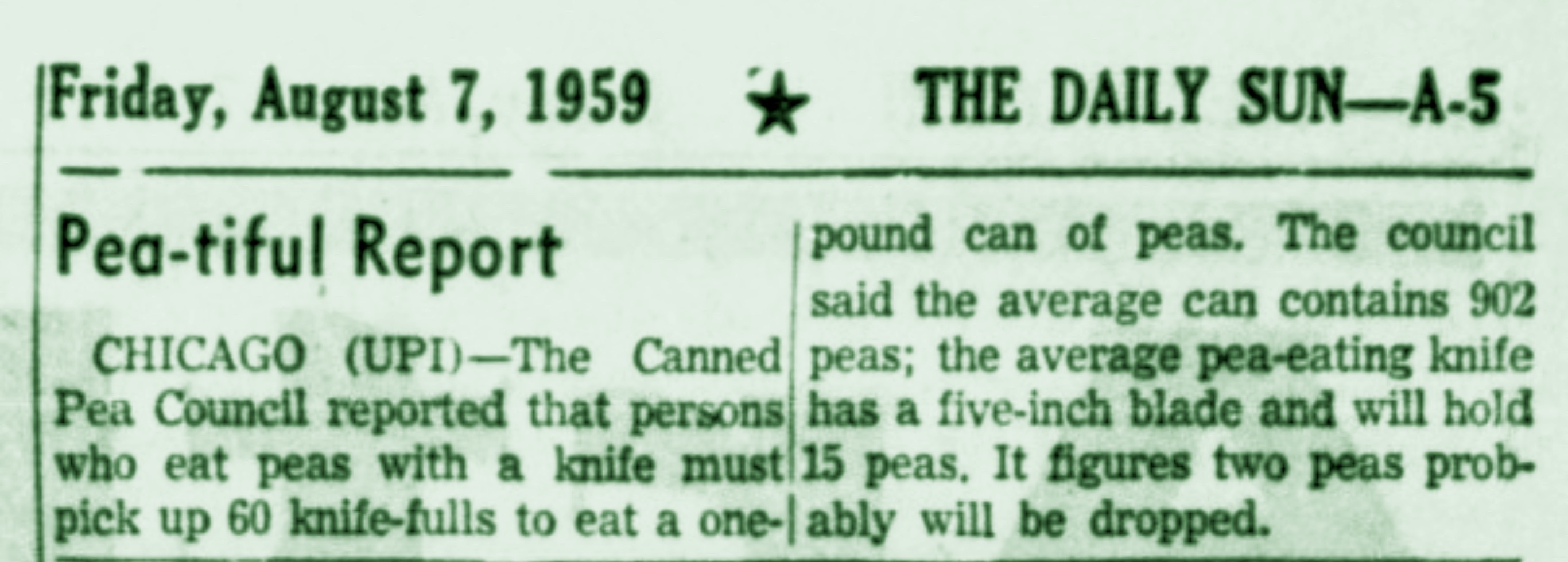
Friday, August 7, 1959 – The Daily Sun -A-5 – Pea-tiful Report

CHICAGO (UPI)-The Canned Pea Council reported that persons who eat peas with a knife must pick up 60 knife-fulls to eat a one-pound can of peas. The council said the average can contains 902 peas; the average pea-eating knife has a five-inch blade and will hold 15 peas. It figures two peas probably will be dropped.


Dining with Dignity –
Dear Sir: I have been troubled with palsy and find it very hard to get a good knifeful of peas up to my mouth. I was compelled to use a spoon, but somehow they don't taste the same. I saw your advertisement in the Echo and I bought a safety pea knife and I want to tell you it's solid comfort. I can't shake them off. God bless you. John Applegate.-From a Vermont paper, 1927


A page from the book, 

What Have We Here?: The Etiquette and Essentials of Lives Once Lived, from the Georgian Era through the Gilded Age and Beyond...


Featured Post

“What Have We Here?” is Here!

What Have We Here? The Etiquette and Essentials of Lives Once Lived, from the Georgian Era through the Gilded Age and Beyond.. . I have spok...