A Family Wedding and Etiquette for Bridesmaids

 
Casey and Sean together for the first dance.

My son turned 23 years old this week. Not a milestone birthday, but always memorable and always a festive occasion.  I mention it because I got pregnant with my son while my husband and I were honeymooning on Bora Bora. 


On our honeymoon, in June of 1990
I was reminded of it when my Town and Country magazine and the accompanying special Town and Country "Weddings" issues arrived this week also.  I bought my first Town and Country magazine in one of the gift shops at the airport, while my husband and I were waiting at LAX to leave for Tahiti, back in June of 1990.  One of the reasons I bought the magazine, was that it was the June bridal issue, and there was an article on honeymoons in Bora Bora, our ultimate destination for our honeymoon.  I have been a subscriber ever since.

You are no longer at a wedding, but are at an event, when the USC marching band is in the house!  The bride and groom met at USC.  Both are USC graduates and Sean played football there as well.

Bora Bora was also the destination for my nephew and his new bride after their wedding on March 8th. The wedding was a wonderful affair.  It mixed old Irish and Italian wedding traditions, was in an absolutely fantastic setting overlooking the ocean at The Resort at Pelican Hill in Newport and it was on a day with surprisingly incredible weather. 
 
True to form, I was checking out the place settings for correctness.  As usual, the flatware was short on room, and a bit mashed up under the service plates, but I have come to expect that.

The bride's mother and father pulled out the stops to make sure it was a memorable and festive occasion for everyone. You know you are no longer at just a wedding, but you are at an event, when the USC marching band is in the house!


A silver "Bell of Truce" was given to each couple, to ring after the bride and groom were married. Irish and Italian traditions were sprinkled throughout the ceremony and afterward, acknowledging Casey's Irish heritage and Sean's Italian heritage.
As I perused my new Town and Country "Weddings" issue, comparing the wedding I had just been to and the weddings in the magazine, I came across a page of etiquette titled "The Bridesmaid's Commandments."  There are ten of them, from a five-time bridesmaid and author, Eimear Lynch.  She "offers tips for navigating the big day with class and a sense of humor." 


There are ten Commandments, from a five-time bridesmaid and author, Eimear Lynch.  She "offers tips for navigating the big day with class and a sense of humor."
The Commandments range from excellent (Number 1 ~ ALWAYS AGREE WITH THE BRIDE...)  to Commandments that are simply common sense (Number 9 ~ DRINK RESPONSIBLY...), but we all know someone who only got to lick the spatula when common sense was being scooped out, so it's not all that common! 

I am a six-time bridesmaid and here above is proof of three.  Sean's mother, (my brother's wife Peggy) and me on the left. In the middle photo, I was in my younger brother's wedding. On the right, I was a bridesmaid for my big sister's wedding.  I am leaving off the 3 from various friends' weddings (in one I was the Maid of Honor) as those dresses were pretty hideous on me.


As a six-time bridesmaid myself, here is more of my take on the Commandments:

Her best Commandment? Commandment Number 5 ~ PICK UP THE PHONE.... Always a good idea in this day in age!  Says Eimear Lynch, "Eighty percent of pre-wedding drama could be avoided if people spoke on the phone instead of sending snippy, insensitive texts and e-mails. If you need to tell the bride something potentially upsetting (such as "I can't make it to your eighth shower" or We cannot have your bachelorette party in the sea Seychelles"), do it on the phone or in person."

I agree. If you need to tell the bride anything important, don't do it by text or email. You need to stay in communication. Face to face communication is the best, but when you can't talk face to face, as the commandment reads "Pick up the phone."


Hours and hours went into planning Casey's and Sean's wedding, down to every detail, including the wines that were served (3 reds, 2 whites and a champagne, all with approving nods from Cliff who had been judging at an annual, not to mention prestigious, international wine competition just the weekend before) to the "Hangover Kit" we received as the valet parking attendant retrieved our car.  I was the designated driver, so I have not had the need to open it.
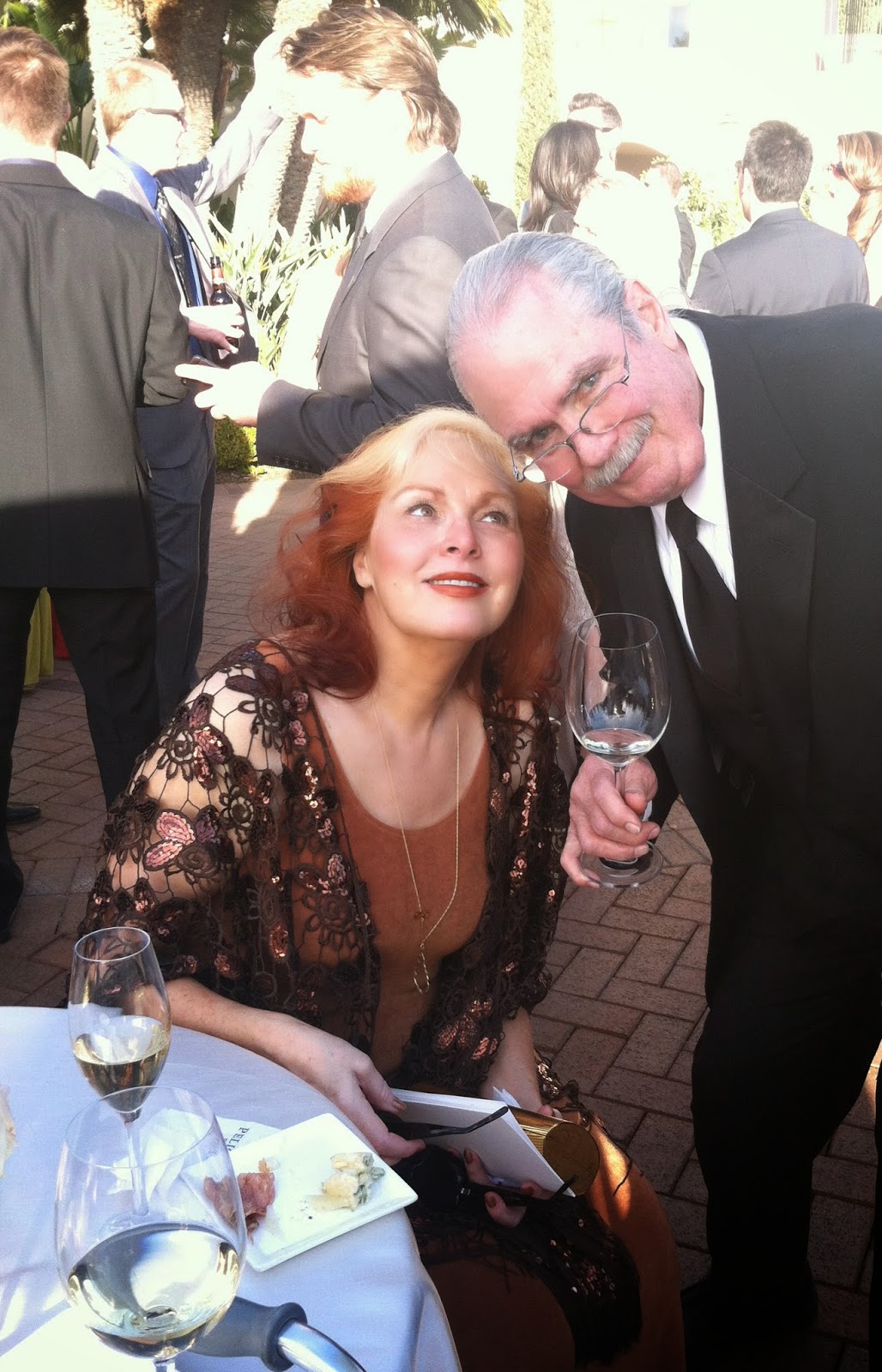
Cliff loved all of the wines, while I was the designated driver who had just a touch of champagne.  When the wedding invitations specify "Black Tie" etiquette dictates that we step up to the plate and make sure our attire is on the very dressy side.
My least favorite Commandment? Number 4 ~ SWEAT THE SMALL STUFF... Writes Ms. Lynch, "You read that right. Weddings are high-stress and ultra-emotional, and a blowout fight candy triggered by something as simple as a mention of the bride's eligible ex-boyfriend. Speak carefully as the wedding draws near, and keep even quieter on the day itself."

In my humble opinion, one should not encourage bridal party members to "sweat the small stuff." Years ago, I knew young woman who told me her grandfather had died at her wedding reception.  Something like that would have devastated me, and most people I know. But that wasn't Tanya. Tanya had a personality that allowed her to just roll with anything and everything that happened to her. In the couple of years I knew her, she never seemed to get ruffled or distracted by anything.

I remember her telling me her reaction to her grandfather's death at the wedding reception. She said, "We were all sad, of course. But he had lived a long, happy life.  The reception was winding down, and he had had a really good time and gotten to see family members he hadn't seen in years. I was really happy the whole family was there to see him off.  His last day was such a beautiful one."

That true story has calmed more brides down than I can count!  Even brides who's weddings I wasn't a bridesmaid in. Anytime a bride started to freak out over something minor, I told them about Tanya's grandfather dying at the reception and would then ask, "Is this as bad as having your grandfather die today?  If not, just let it go.  It's not that big of a deal."  It's such a shocking story and question, everyone goes silent, and it's almost as if you can see the gears working in their brains as they're thinking "Wow! This isn't anything near that bad! In fact, this is really nothing!" Suddenly it calms everyone down, and the wedding can move forward. The mini-drama is stopped in its tracks by hearing about a real life major trauma.

So I know for a fact that sometimes, maybe hearing about someone else's "big stuff," can play a role in calming brides down, by taking their minds off of their "small stuff."


Wedding Photography Etiquette 101 from My Husband ~ "Don't even consider bringing in a 'real' camera with you, as you and your flash may get in the way of the professional hired for the event. Use your cell phone like everyone else!" Which is what I was forced by Cliff to do.  Most of these photos were taken by Cliff with his phone, and a few were taken with mine.  My camera was left in the car.

My favorite Commandment is Number 8 ~ Remember: This isn't even A LITTLE BIT About You
It really isn't about bridesmaids.  It is all about the bride.  That's why we wind up shelling out money for dresses we feel pretty hideous in, and don't ever really wish to see the wedding photos again. 


Congratulations to Casey and Sean! We hope you enjoyed Bora Bora as much as we did!


Etiquette for Weddings from the 1887 book 

"How to Behave" 


"We copy from one of the numerous manners books before us the following condensed account of the usual ceremonies of a formal wedding. A simpler, less ceremonious, and more private mode of giving legal sanction to an already existing union of hearts would be more to our taste; but, as the French proverb has it, Chacun à son goût.


For a stylish wedding, the lady requires a bridegroom, two bridesmaids, two groomsmen, and a parson or magistrate, her relatives and whatever friends of both parties they may choose to invite. For a formal wedding in the evening, a week's notice is requisite. The lady fixes the day. Her mother or nearest female relation invites the guests. The evening hour is 8 o'clock; but if the ceremony is private, and the happy couple to start immediately and alone, the ceremony usually takes place in the morning at eleven or twelve o'clock.


If there is an evening party, the refreshments must be as usual on such occasions, with the addition of wedding cake, commonly a pound cake with rich frosting, and a fruit cake. The dress of the bride is of the purest white; her head is commonly dressed with orange flowers, natural or artificial, and white roses. She wears few ornaments, and none but such as are given her for the occasion. A white lace vail is often worn on the head. White long gloves and white satin slippers complete the outfit. The dress of the bridegroom is simply the full dress of a gentleman, of unusual richness and elegance.


The bridesmaids are dressed also in white, but more simply than the bride. At the hour appointed for the ceremony, the second bridesmaid and groomsman, when there are two, enter the room; then, first bridesmaid and groomsman; and lastly the bride and bridegroom. They enter, the ladies taking the arms of the gentlemen, and take seats appointed, so that the bride is at the right of the bridegroom, and each supported by their respective attendants.


A chair is then placed for the clergyman or magistrate in front of the happy pair. When he comes forward to perform the ceremony, the bridal party rises. The first bridesmaid, at the proper time, removes the glove from the left hand of the bride; or, what seems to us more ceremony. In joining hands they take each other's right hand, the bride and groom partially proper, both bride and bridegroom have their gloves removed at the beginning of the turning toward each other. The wedding ring, of plain fine gold, provided beforehand by the groom, is sometimes given to the clergyman, who presents it. It is placed upon the third finger of the left hand.


When the ceremony is ended, and the twain are pronounced one flesh, the company present their congratulations—the clergyman first, then the mother, the father of the bride, and the relations; then the company, the groomsmen acting as masters of ceremonies, bringing forward and introducing  the ladies, who wish the happy couple joy, happiness, prosperity; but not exactly "many happy returns."


The bridegroom takes an early occasion to thank the clergyman, and to put in his hand, at the same time, nicely enveloped, a piece of gold, according to his ability and generosity. The gentleman who dropped two half dollars into the minister's hands, as they were held out, in the prayer, was a little confused by the occasion.


When a dance follows the ceremony and congratulations, the bride dances, first, with the first groomsman, taking the head of the room and the quadrille, and the bridegroom with the first bridesmaid; afterwards as they please. The party breaks up early—certainly by twelve o'clock.


The cards of the newly married couple are sent to those only whose acquaintance they wish to continue. No offense should be taken by those whom they may choose to exclude. Send your card, therefore, with the lady's, to all whom you desire to include in the circle of your future acquaintances. The lady's card will have engraved upon it, below her name, "At home, —— evening, at _____ o'clock."  They should be sent a week previous to the evening indicated."

My Jane Austen Etiquette and Regency Era Lexicon Grows

"High-change in Bond Street, - ou- la Politesse du Grande Monde."  Sums up some rudeness in the Regency Era;   Fashionably dressed pedestrians on Bond Street. In the foreground, five men crowd a woman and girl off the sidewalk as they leer at them. The women, seen from the back, are oddly dressed. In the background, three ladies, also in exaggerated costumes, walking arm-in-arm in the roadway.

As I continue to read these books of Jane Austen's, I cannot help doing a bit of research.  I guess it is just a natural thing I should not fight.  So the following is my 3rd installment of definitions in my lexicon of Regency Era words and phrases:

Alloy : tempering, or tainting, through emotions

Brook: put up with something painful or difficult


Casino: point-scoring card game in which players combine cards exposed on the table with the cards in their hands, the 10 of diamonds being the highest-valued card
No, Anne Elliot's sister does not suffer from colicky gout. She suffers from hypochondriasis.
Colicky gout: abdominal pain and swollen joints, especially the toes and feet

Consequences: a pencil-and-paper game for several players, in which each player adds a line of a story without knowing with the previous lines are. The resulting stories are incongruous and humorous.
"While they were at breakfast, the letters were brought in. Among the rest there was one for Colonel Brandon; he took it, looked at the direction, changed color, and immediately left the room." from "Sense and Sensibility

Direction: return address

Douceur: pleasantry


Exigence: exigency; urgency


Illiberal: narrow minded; bigoted


Importune: troublesome; overly persistent in request or demand
Best dressed goose I've seen in a while!
Michaelmas: September 29th, the feast in honor of Saint Michael. One tradition is that if a young lady finds the ring hidden in a Michaelmas pie, she will soon marry.

Natural child: child born out of wedlock


Pall-Mall: main thoroughfare in the Saint James district of London
Queen Mab is a fairy referred to in Shakespeare's play Romeo and Juliet.  She later appears in other poetry and literature, including Jane Austen's
Queen Mab: Queen of the fairies in English literature

Rubber: session or round of playing a card game

The Art and Etiquette of Setting a Beautiful Table

... Not to Mention Throwing a Fabulous Bridal Shower! 

A beautiful welcome to a bridal shower for my nephew's fiancée, Casey!

A friend, Elle Richesse, recently gifted me with a subscription to Tea Time magazine.  Not being a big tea lover (as many of my readers know) I was still looking forward to the magazine, as I knew it would be filled with beautiful pictures, stories and features on various tea rooms.  I'm always up for a good cucumber sandwich, and tea rooms are generally charming places to visit.
Taking photos from an old Architectural Digest and tweeting from my doctor's exam room.  Surprisingly, he was interested in my thoughts on place setting etiquette.  Then again, his daughters were in my etiquette classes years ago.
I was pleased to see on the cover when the first issue arrived, that table settings would be featured and a Downton Abbey tea.  A big Downton Abbey fan, I was looking forward to reading about Downton and seeing the table settings.  
Tea really isn't "my cup of tea," but the articles in this magazine really are terrific.  Thank you again, Elle!

I am known for zeroing in on table settings the moment I see a table set. It comes from years of judging tables, setting tables, and an enthusiasm for a certain symmetry.  It's sort of like my bizarre counting the rings of ringing telephones on tv and in movies, but that is for another post.  It's not something I want to do mind you, it just happens. Its the same thing with table settings and me. It doesn't matter if I'm flipping through a magazine or walking through a restaurant. I see a place setting and immediately start looking to see if it is correct or incorrect. So flipping through Tea Time and to the Downton Abbey Tea... Oh dear...
Almost Downton Abbey style, but those forks would never be placed on the napkins!
One of my biggest peeves with place settings? Those which have forks placed on the napkins.  One's guests should not have to reset one's table, but that is exactly what a host or hostess is requiring their guests to do when they place forks on napkins.  The guests have to take the 2, or possibly 3, forks off of the napkin with one hand, retrieve the napkin to place in their laps, then replace the forks back down in their correct order. 
Napkin in the center of the place setting

A napkin belongs in the center of the place setting, if you really want your guests to use them nowadays.  Napkins placed to the left of the forks are okay in my book, but again, I want my guests to put their napkins in their laps.  Placing them on the table or service plate, in the center of the setting, means that your guest has to remove the napkin to have food placed in front of him or her.  I have seen napkins set to the left of the forks go completely unused, so I do not recommend placing napkins there.
 
Napkin to the left of the forks, in a napkin ring.

Now I understand why magazines and catalogs show gorgeous settings with the forks on the napkins.  It is either to show off more on an already crowded table, with limited space on the page, or it is that the stylist or photographer has no idea that placing the forks on the napkins is improper.  Those photos are not nearly as irritating as the old magazine and catalog, "mirror -image" backward place settings, that had the photo transparencies reversed prior to printing.  Seeing those photos of really beautiful but backward tables, always made me nuts!  So walking in to see these gorgeous tables set with such flair for the bridal shower Sunday... I was thrilled.
The settings Sunday?  Wonderful! 

The bridal shower Sunday was just beautiful.  Really stunning. 
 
Kudos to Peggy, and my niece Kelly.  They outdid themselves on this shower!

Kelly and Peggy have a surprise basket of roses for Casey from Sean.   Each had a note attached with a different reason why he loves her.  So sweet.

As I was admiring the tables and taking photos, a good friend of Peggy's, chef Cathy Mc Knight, told me that Peggy had gotten the vintage glasses, mismatched antique  silver flatware, etc... from a company called Archive Rentals.  I was dying to talk with Peggy about the settings, but didn't want to pester my sister in-law, as she and my niece Kelly had their hands full, putting the finishing touches on everything. 

Cathy's son, Scotty, is a groomsman in my nephew's wedding, as is a young man named Garrett Beck.  I had interviewed the three of them on sports etiquette back when they were all buddies in eighth grade.
Garrett, Sean and Scotty all grown up!  I still have my taped interview with them on sports' etiquette though, and am planning a blog post using their thoughts from 13 years ago.  All are still excellent etiquette tips!
Amanda Ngyuen (from my post on calling cards), a dear friend Maria Basdakis, Cathy McKnight and myself.  I spent a whole year and a half on the east coast and picked up that "no white after Labor Day" habit, so when the invite requested we, "Wear white or a favorite white accessory." I could only bring myself to wear a white jacket, even though it was a warm 80 degrees outside.
I also spotted Cindy Beck and chatted about Garrett.  She was exhausted, but also very excited and told us about her son in-law, Olympian Bode Miller's latest medal.  She had gotten texts from her daughter in Russia at about 4:00 a.m. and was thrilled for his win.

 
Me with Cindy Beck... Cheers to Olympic medals and a lovely afternoon!
Peggy had Yolanda Thayer there.  She has a company called "Perfume Bar Soiree" and mixed perfume for each guest.  We got to choose from the different top notes, etc... to create our own personal scent.  She had a label to place on the bottle and asked what I wanted to call my scent. All I could think of was "Etiquette."  The gift boxes at everyone's seats, held a different vintage or antique crystal perfume bottle.  No two were alike.   

 
One of Casey's bridesmaids, Emily with Amanda of "Feast.Fashion.Faves" along with my son Robert's girlfriend Kelsey, at Yolanda's table of "Perfume Bar Soiree"

Great food, wonderful company, scintillating scents and beautifully set tables.  What more could one ask for in a bridal shower?

Casey opening the gifts Kelsey and I brought for her.
Peggy and Kelly had a white, tufted seat raised up for Casey to sit on while she opened her gifts.  She looked just like a princess!


Victorian and Edwardian Era Bridal Shower Etiquette

The bestowal of engagement presents has of late years taken on a wholesale aspect. Instead of the occasional receipt of a present from one or another of her friends and relatives, the bride-elect is often now the guest of honor at one or more parties called "showers," and the recipient of numerous gifts which are literally showered upon her. There are many kinds of "showers," as many as the ingenuity and financial resources of friends may admit of. When, however, any one bride is to be made the object of a series of such attentions, it is well for the girl's friends who have the matter in hand to see to it that no one person is invited to more than one shower, or, if so invited, that it be at her own request and because she wishes to make several gifts to her friend.  These affairs should be purely spontaneous and informal, and occasions of much fun and jollity. Nevertheless, there is danger of overdoing the idea, and making the recipient feel burdened rather than gratified by the zeal of her friends in her behalf.
 

Effort should be made not to have the articles given at a "shower" duplicate each other. They should be some simple, useful gifts, which will be of immediate service, and need not be either expensive or especially durable, unless the giver so desires. A "shower" is usually given when a wedding is in prospect, and the necessity of stocking up the new home confronts the young home-makers. The aim is to take a kindly interest in the new home and help to fit it out, more in the way of suggestion than in any extravagant way, which would make the recipients feel embarrassed or indebted, or overload them with semi-desirable gifts.
 

The "shower" is usually in the afternoon, and is joined in almost exclusively by the girl friends of the bride-elect, with perhaps a few of her older women friends and relatives. If, however, it comes in the evening, the men of the bridal party are usually also invited. The refreshments are simple and the style of entertainment informal. The invitations to a "shower" are usually given by the hostess verbally, or she sends her cards by post with the words "Linen shower for Miss Hanley on Wednesday at four."
 

There is a wide range of possible kinds of "showers," but the only rational way is to choose for a donation party of this sort only such objects as will be needed in quantity and variety, and in the choice of which one has not too strong and distinctive taste, as, for instance, the following: Linen, towels, glass, books, fancy china, silver, spoons, aprons, etc. Of course, the furnishings of some one room, as the bath-room, laundry, or kitchen, might be the subject of a "shower," but usually a housewife would prefer to have what she wanted and nothing else for use in these places.


From Etiquipedia

Antique perfume bottles and scents to choose from, at the ready... 
Best wishes to Casey for a beautiful wedding!


More Etiquette and Regency Era Lexicon

Making sense of "Sense and Sensibility" and other works of the Regency Era, Part 2.5

"What do you mean 'you are getting ready to read another book'?!?"
I am getting ready to read another book. No, I am not referring to more research from more old etiquette books that clutter my home. This is an actual novel. I am on some sort of roll, reading two novels in twenty years. Who knows? I may continue this as a trend.

This is another book by Jane Austen, but it was completed after her death. The book is "Sanditon: Jane Austen's Last Novel Completed" loaned to me by my sister in-law Peggy. Getting ready to start this book, I thought I should first study up on the archaic phrases, terms and words of Jane Austen's Regency Era. The following are those I am adding to the growing list that is my "Regency Era Lexicon";


Assiduities: persistent personal attentions
Enormously popular with lower-class Londoners, the Bartholomew Fair was an annual, carnival-type event.
Bartholomew Baby: A person dressed up in a tawdry manner, like the dolls sold at Bartholomew Fair (a two-week festival celebrating the Feast of St. Bartholomew). 

Bear leader: A travelling tutor, who leads his charges as if they were trained bears

The world’s most famous mental hospital, Bedlam.  Its name derives from the "Church of St Mary of Bethlehem"
Bedlam: An insane asylum in London. The full name was the Hospital of Saint Mary of Bethlehem.
 

Bit o'muslin: A woman of who gives sexual favors in exchange for payment

Ignatius Bonomi, an English architect and surveyor.
Bonomi: Ignatius Bonomi, a well known architect at the time

To be played on a Bowling Green
Bowling Green: grassy lawn where game of ninepins could be played

Cavil: a trivial objection

Conjurer: someone who draws astute conclusions

Covert: a thicket providing cover for game

A Curricle Match "I have an IDEA my Lord, that nothing but time or a stone wall will stop them and I'll bet a cool hundred that Frank will not head them for the next mile."


Curricle:  a light, two-wheeled carriage drawn by two horses, side by side

Ebullition:  a sudden outburst, as of emotion

Theatre Royal, Drury Lane ~ Engraving, from the stage, looking into the auditorium
Drury Lane:  general term for the Theatre Royal; street were the London playhouse is located

Enclosure:  common land, previously used by everyone, this is fenced in by the landowner so that others can't use his land for pasture or gathering fuel

Gigs:  light, open, two wheeled carriages

Pear-shaped, ivory vinaigrette, for holding for the Regency Era lady's smelling salts
Hartshorn:  smelling salts or spirits
 

Had as lief:  would just as soon, would just as readily or willingly
"Accomplished women" of the era had mastered several pastimes; Needlework, Playing an instrument, Singing, Painting, etc...  A huswife held items for sewing and needlework

Huswifespocket cases for needles, pins, thread and scissors, forerunner of "housewife"

Importune:  troublesome, overly persistent in request or demand

Incommode:  inconvenience, disturb

One gent lacks money, the other lacks charm; Both suffer from an inferiority of parts.

Inferiority of parts: lack of talent or capabilities

Knowing:  fashionable


La Boulangere: a simple circle dance for a group of couples
"Because breakfast was so late, there was not a regular lunch."
Nuncheon:  also "nunchion," a light, noon drink or snack, forerunner of the word "luncheon"

Offices: parts of the house in which servants work

Open weather:  mild and free from frost

Piquet, a classic game originating in France where it was the dominant card game for many years.
Riding side-saddle

Piquet: a card game for two players, with 32 cards

Porter: a dark brown beer made from charred or brown malt


Post-Horses: horses used or kept at inns, or post-houses, for use by mail-riders, or for hire by travelers

Public School:  in England it is a private school

Red-Gum:  swelling and redness due to teething

Retailed:  repeated

Serviley:  in the manner of a slave
The Inner Temple is one of the four "Inns of Court"

Temple:  one of two sets of buildings in London's Inns of Court, which served as residences for lawyers and law students

Whip Hand:  upper hand, advantage (the hand that holds the whip controls the carriage or horse)

Work-bags:  bags for needlework

Etiquette for Calling Cards and Business Cards in the Digital Age

“Hello, My Name Is ...”
 Long before name tags, calling cards made the introductions in polite society." from Country Living Magazine, February 2014

When my husband and I got engaged, my mother in-law gave me a truly wonderful gift. As my husband was named after his grandfather, Clifford Clement Graber, my mother in law gave me the remaining calling cards from his grandmother, the original Mrs. Clifford Clement Graber, along with the engraving copperplate used to engrave the the cards. Not exactly usable in this day and age of business cards, but a gift I have cherished over the years. To me, it is a real treasure.
 

An engagement gift from my mother in-law, Betty Graber. 
I am always happy to see my Country Living magazine arrive. I enjoy most, the sections on collecting and what different antiques and collectibles are worth. In February the article on collecting is on shallow trays used to collect calling cards. I had been wanting to share this for a while now, and thought today is the perfect day.

Calling cards were used by people from the Regency, Victorian and Edwardian eras, and quite possibly long before that, but they were especially popular at the height of the Victorian era.


These trays, or tazas, could be quite elaborate and pretty.
Others were very plain. 

Being a product of the generation I am, the only calling cards I was familiar with were business cards. I remember my first business cards. They were for my first boutique. Someone gifted me a black and gold-toned business card holder. I was thrilled. I felt rather important with my business cards, and carried them with me always, pleased to hand them out to new acquaintances and potential customers. I had heard about calling cards, but was not really familiar with how they were used and their importance in social life just 50 to 60 years earlier.


My husband when he was about 12 years old, along with his sister and parents, on the boat named after his paternal grandmother, Georgia Belle. 
From Country Living magazine's article, I learned about austere calling cards. That "true upper-crusters (think Downton Abbey) engraved their cards with nothing more than a name." From what I've heard of her, Georgia Belle Graber would have probably been shocked to find that she was considered an "upper cruster" due the simplicity of her calling card.


According to my mother in-law, Betty Graber, Georgia Belle Graber was a "homebody" who could never be confused with the Granthams of Downton Abbey. 

Country Living magazine writes that no proper lady or gent paid a social visit without first presenting a host servant with a calling card capable of conveying all kinds of meaning.

When writing this blog post, I called my mother-in-law, Betty Graber, to find out what her calling cards were like. She told me of the two times she had acquired them. The first, was upon graduating from high school. "It seems really stupid, but I didn't like my name. I ordered them to read 'Betty Lee,' when they should have read 'Mary Elizabeth.'" I assured Betty that I understood. Most teens don't like their names.

Betty's second box of cards read "Mrs. Robert D. Graber" and she received them from her mother at her bridal shower when she was marrying my father in-law, the man my 22 year old son was named after. "I can remember the ladies arriving for the shower, dropping their cards into a gold dish sitting on a small table, as they entered our house. My mother normally had a pretty, china plate sitting there for cards, or a small white dish. This one was gold. It was special for the occasion. I don't remember what it was made of... It could have been gold-plated. I don't know. But it had a texture to it and I can still see it now." As she told me all of this, it was as if the shower had just been yesterday. My mother in-law is 97 years young, and as "sharp as a tack," as my father always says.

Back when they were still being used, the etiquette for calling cards, was very strict and well-defined. Here are a few of the rules; 

HUSBAND AND WIFE- When the wife is calling,

she can leave cards of the husband and sons if it
is impossible for them to do so themselves.

After an entertainment, cards of the family
can be left for the host and hostess by either
the wife or any of the daughters.


LEAVING CARDS IN PERSON- When cards with a message
of congratulation are left in person,
nothing should be written on it.

LEAVING CARDS IN PERSON AT AFTERNOON TEAS-
Women leave cards of their male relatives
as well as their own, although their names
may be announced upon entering the drawing-room.
Guests leave their cards in a receptacle
provided, or give them to the servant
at the door.

MEN- A bachelor should not use AT HOME
cards as a woman does, nor to invite his
friends by writing a date and MUSIC AT FOUR
on his calling card in place of an invitation.


For more on the rules of calling cards, check out this post on the Etiquipedia Blog.


Having run my own business since 1984, I really have had no use for the calling cards my mother in-law so graciously gave me. Still I treasure them. They are eternally linked to a romantic notion of the past, as well as my husband and his family. Like all good things, calling cards could have either died out, or adapted as time marched on. Reluctant to die out in the modern age, the old fashioned calling cards evolved into business cards.

Regardless of my 26 year old daughter announcing very matter matter-of-factly to me that "No one uses business cards anymore." I am glad to know people do. Case in point? My nephew’s girlfriend, Amanda Nguyen.

The lovely, and always fashionable, Amanda Nguyen


Last July, at my niece's engagement party, Amanda and I got to talking about blogging. I asked her if she had a business card. She quickly pulled a card from her purse and handed it to me. I was impressed. And at the same time a bit intimidated. Amanda's card not only has her email address on it, but it shows you how to reach her on Facebook, follow her on Twitter, look at her photos on Instagram, see what she likes on Pinterest, and check in with her on Tumblr.


Amanda's card is perfect for this digital age we are living in. After all, if you are online, people shouldn't have to search for you.


Now, I'm on Google+, I'm on Blogspot, I'm on Twitter, etc... but none of those things are on my business card. The only digital information I have on my business card, I am sorry to say, is my website. I quickly realized I'm in dire need of a business card makeover.


I like my card, but with just my website, it is definitely not ready for prime-time!


I have always liked my business cards. My business cards feature a penguin logo that fits in with a black and white concept for my business, colors that are always elegant together. And penguins always look like they are dressed for a special occasion. Can you think of another animal that dresses in a tuxedo 24/7?

Suffice it to say, I have made a New Year's resolution to update my business cards to reflect the Digital era we live in. After all, if my husband's grandmother's calling cards were out of date for me in the late 1980s, my business cards are just as outdated for me to be using in 2014.


Business Card Etiquette for Around the Globe I found online:


Global Business Card Etiquette


By Guest Blog Post Author David Grebow on behalf of VistaPrint.com

Using a business card correctly in a global economy takes some knowledge about the way other cultures use their cards. Here’s a short primer on business card do’s and don’ts

Doing business in a flat world means you will be doing business with people from other countries. Whether you are traveling to a meeting in another country, or the people from another country are coming to meet with you in the U.S., etiquette is etiquette. It is important to show that you know the proper way things are done in their country.

As it happens everywhere, the meeting usually begins with the passing of the business cards. I said usually, but we’ll get to that. First, the general rules of playing international business cards.
In most countries, with the exceptions being North America and Western Europe, the exchange of business cards is a ceremony of great importance.
Let’s begin with some general tips.


The current universal standard has not changed in many years. The business card still needs to include the name of the person, the company name, a company logo, if applicable, and the relevant contact information, including:

Street address
Postal code
Country
Telephone and fax numbers with country codes, and
Email addresses
Traditionally, black ink is used on white card stock. The typeface, usually serif, should be legible and professional-looking. The international standard for card size is 85.60 x 53.98 mm (3.370 x 2.125 inches).
Business cards are an internationally recognized means of remembering who was at the meeting. Make sure you have enough clean cards and that they contain the most up-to-date contact information.
Here are more tips on the card exchange:


When you are presented with a business card from anyone, make a point of looking at it and asking any questions you might have about the information printed on it. Do not just slip it into your pocket.
Business cards are generally exchanged at the beginning of the first meeting and not at any followup meeting unless new people are in the room, and then only they exchange business cards.
Do not carry your cards loose in your pockets or allow them to become bent or dirty. Invest in a small, discreet card case.
Never write on your card or on any card you receive unless directed to do so.
In North America and most of Europe, it is acceptable to have a simple statement or selling point about your business or service. However, it’s not such a good idea when presenting the card outside those geographical regions.
A few words about words. It is good etiquette for any meeting with businesspeople from another country to also print your contact information in their language on the back of the card. It is also good business etiquette to present the card so the recipient’s language is face up and facing them so they can read it as you hand it to them.

Hire a professional translator or agency and make sure your title indicates your position in the company hierarchy. Also make sure the correct dialect is used, and that any cultural nuances are observed. For instance, foreign translations of business cards for use in China are often printed with gold ink, which is considered auspicious.

Now for the fun part: Other countries and other business-card presentation etiquette. Here are a few of the key tips to remember:
Japan:


Business cards are considered an extension of your business and are exchanged with great ceremony. (That’s why this list of proper etiquette is so long.)
Invest in quality cards using a better card stock than you would normally choose.
Always keep your business cards in pristine condition.
Treat the business card you receive with great respect.
Make sure your business card includes your title since the Japanese place emphasis on status and hierarchy.
Business cards are always received with the right language facing the receiver using two hands holding the card by the corners.
When receiving a card, bow out of respect and read the card as if to memorize the name and title so you can match it to the person later.
If you are presenting cards to more than one person start with the highest ranking individual and move down according to the protocol of rank.
Never present a business card during a meal.
During a meeting, place the business cards on the table in front of you in the order people are seated.
When the meeting is over, put the business cards in a card case or a portfolio, not in your pocket.

China:


Have one side of your business card translated into Cantonese or Mandarin and printed in gold ink.
Your business card should include your title.
If your company is the oldest or largest in your country, that fact should be highlighted on your card.
Same basic presentation rules listed above for Japan also apply to China. Hold the card in both hands when offering it and bow, and carefully read the card when you are on the receiving end.
Present your card before you ask for one from the recipient.
Never write on someone else’s card unless so directed, since it is considered a sign of disrespect.

India:


If you have a university degree or any honor, put it on your business card.
Always use your right hand to give and receive business cards. Note: This practice should be followed with businesspeople from any Islamic country as well as from many parts of Africa.
Business cards need not be translated into Hindi as English is widely spoken within the business community.
In India, business cards are exchanged even in non-business situations, generally after the initial handshake and greeting.
Always present the card in a way that the recipient may read the text as the card is being handed to them.

Korea:


When you receive a business card from a Korean, simply nod your head as a gesture of respect and thank the person for the opportunity to meet with them. No need to bow.
Unlike in other Asian countries, it is appropriate to put the card away immediately in a simple card holder. Looking at the card too long is regarded as ignorant and impolite.
It is preferred that you present your card to a person before asking for their card.
Again, present your card with both hands, Korean text side up, text facing toward the recipient, and give a gentle nod of the head. The nodding of the head is especially important when meeting with individuals senior to you.

Brazil:


Language, again, is important. When you conduct business with a Brazilian, have business cards printed one side in English and the other in Portuguese.
Distribute these to everyone present when they arrive, making sure the Portuguese text is facing up.
If you arrive first, present your cards right away.
Here are a few general rules for other countries, as well:


In Iran, only senior-level individuals exchange business cards.
In other Arabic nations, like Kuwait and Saudi Arabia, cards are given to everyone you meet.
In Hungary, on the translated side, your surname should precede your given name.
In Spain and Turkey, the business card should be presented to the receptionist upon arrival.
As you can tell, every country has its own way of conducting business and its own business card etiquette. Make sure, aside from learning the above rules, that you talk with someone who does business with the country you want to learn more about. Use the library or go online. Contact the Department of State or the country’s embassy. What you do — or do not do — will set the tone for your entire meeting.

From http://www.pingo.com/blog/index.php/global-business-card-etiquette/By David Grebow, a freelance business journalist who writes for Vistaprint, a global leader in marketing products and services for small businesses. David is a writer, editor, and author of many books, including “A Compass for the Knowledge Economy.” He holds an MBA from Harvard, and his work has been published in Harvard Business Review and The Economist.

Featured Post

“What Have We Here?” is Here!

What Have We Here? The Etiquette and Essentials of Lives Once Lived, from the Georgian Era through the Gilded Age and Beyond.. . I have spok...