A Lost Art.... Setting a Correct Table

   For many years I had the privilege of co-sponsoring the largest tablescaping competition in America.  Held yearly at the Los Angeles County Fair, many competitors put a whole year's worth of time into designing tables in an effort to win top prizes, even if the themes were not announced until just a few short months prior to the competition itself.  
The was a "booth" from a speakeasy a la "Chicago"
   I have many memories from my years of sponsoring and judging, but there were often times that I had to back up my calls on tables which were not quite right, with regard to etiquette.  Yet it was several questionable etiquette decisions that led to me leaving my card at the information booth after viewing the tables for the first time.   
Me judging a Military themed table.
  I went to the fair with the family in the early 1990s. Getting  out of the heat, we all wandered into the Home Arts building and spotted the tables. Viewing the tables, reading the corresponding menus submitted by the competitors and the judges comments, I noticed several people had been docked points when a table was set perfectly.  Other tables that won the top prizes, were set incorrectly. I overheard other fair goers mentioning some of the same errors.

Christmas table with ornate custom tablecloth.  
   At a nearby information booth, I asked who had judged the tables. Told the judges were retired Home Economics teachers, I gave my business card to the woman in the booth an asked that it be passed along, noting the judges made several errors.  I forgot all about it until the following spring when I received a call from the head of that department, asking me to judge.  I was more than happy to judge table settings.  I had enjoyed setting the table at my grandmother's house, and even at my friends' homes when I was young.  It is truly a lost art.

   That first year, the 24 tables, divided up into 6 different themes, were each set 3 different times.  They would stay on exhibit for about a week, then new competitors would set new tables, and so on.  The first judge I worked with was about 35 years older than me.  To her, I was just a young pup with an etiquette business.  Now, there is no degree, nor government agency, nor oversight committee, or any other actual certification for being an etiquette instructor regardless of what some companies charge unsuspecting new instructors for bogus certification. But this woman had a degree in Home Ec. and she had started judging the tables before we were even scheduled to begin. "I've already picked the winners. You can help with the comments." was her opening line after I introduced myself.  Huh?!?  Was she kidding?  No, she was serious.
Stunning Asian themed tables
  She said she had been judging tables, preserved foods, baked foods, etc... at several county fairs for years.  She was a bit blasé about the whole thing, but I wanted to check the tables out for myself.  I didn't want to step on her toes, so I figured I would go through the "winners" with her and see if I concurred.  I found a glaring error on the first table set for 4, that she had deemed a 1st place table.   

  "According to the card, this is a formal dinner?  Why are there cups and saucers for coffee at the table?  That's incorrect."  She disagreed with me, but I stood my ground.  I am sorry, but at a formal dinner, one does not set coffee cups, saucers and spoons at the table.  That is the rule. I didn't make it up. A luncheon?  Yes.  But at a formal dinner table?  No. Check any etiquette book."  We moved to the next table. "Why are there bowls at the settings? There is no soup or other food on this menu that would require a bowl to be on top of the dinner plate."  I was told that the bowls were there because "... they came with the set of dishes."  She was serious.  She felt it was perfectly okay to have a large soup bowl at each place setting, with no soup on the menu. 

   It was at about this point the head of the department came over to see how we were getting on.  The other judge was not pleased with me, but the head of the department was interested in what I had to say and agreed with my calls on the proper etiquette. There was a bit of a chill in the room and it wasn't the air conditioning. We made it through the first tables and I went home exhausted.  
Close-up of safari setting
In all fairness, the experience the other judge brought to the table was extremely helpful. She made some great observations with regard to the custom table cloths & napkins that many competitors made. The tables are too big for 2 settings & too small for 4, so table cloths had to be customized for the tables to look their best.  She also noticed other little artistic details that I wouldn't have picked up on. She also knew a lot about the foods on the menus. I had never given much thought to menus unless I was ordering something in a restaurant, so that was a plus.
Details from a Safari themed table
  The following week I was working with another retiree.  A friend of the first judge.  She was very enthusiastic and said, "The rule is you have to say 3 nice things about each table."  I hadn't heard that rule before with regard to comments.  It may sound easy, but if a table is set completely wrong, with forks on the right, spoons, knives and glasses on the left, plates askew, and one hot mess of a design, how does one come up with 3 nice things to say?  

 We were half-way through the tables when the department head came out with a letter of complaint from an entrant in the previous settings.  It was a 4 page, typed letter, complete with a copy of page from an old Emily Post or Amy Vanderbilt etiquette book.  A book I have in my library.  It was about the formal dinner table with the cup, saucer and teaspoon.  "She is very upset!  She was even in the newspaper setting this table up.  She is a long time competitor!"  I read the letter and pointed out that the entrant had included the exact rule I had cited when docking her points.  "The rule is stated right here.  She provided the rule and is upset that we marked her off?" I offered to call the entrant and explain that she really hadn't read the book she provided us the portion from. 

 She was very gracious over the phone. "My mom showed me the rule after I sent that letter!  I missed it.  I am so sorry."  She told me she had been competing for a while and had even helped with her mother's tables before she was old enough to compete herself. Now, she and her mother competed against one another. She mentioned that neither one had never been marked off for cups and saucers before. I told her I hoped to make the judging more uniform in the coming years, and I did just that.

Posted are a few of my favorites from the 10 years I judged.  I will post more about the competition in future blog posts, and some tips from top prize winning competitors (Eda Bierman & Candace Mayeron) I have come to know as friends since I stopped judging.

Facebook and Now LinkedIn As Well... Frightening!

Halloween 1984


Who needs Halloween for tricks, treats & frights when we have Facebook and LinkedIn?  Worldwide, security breached, plagues of portals, for your past to come back to haunt you 365 days a year.  They suck more out of one's life than anything from Twilight or True Blood, and have more surprises at every turn than well crafted, amusement park haunted houses.  

They also, rather nonchalantly, heist email addresses from your computer with a simple question like, "Want to see if any of your contacts are also on (whatever site one is on)?"  One click and every person I have ever sold things to on Ebay, or whose email address was sent to me because only a small portion of the population seems to know what "Bcc" stands for, then pops up.  I closed my Facebook account 2 years ago, and just recently discovered LinkedIn had become just as intrusive.  

I was getting requests from people I may have exchanged one or two emails with, or parents whose kids I taught 10 years ago, and so on.  I only have my company name, phone number, etc... now, and I no longer accept invitations to connect with others.

I tried Facebook at the requests of friends, not realizing that the requests were from the portal itself, not really from my friends.  After signing up, I was bombarded daily with long lists of people that, yes I did know, but possibly didn't want to share anything other than a business connection.  I wondered, How did Facebook know I knew these people? I looked at the list and got it. Facebook pulled them from your email account, you big dumb bunny! 

With several email addresses, I knew why Facebook wanted to be in my email account and I was none too happy. However I figured that as I was finally connecting with some old friends who I rarely get to see, I would just ignore the pleas to add them as my Facebook friends. Common sense took a back seat for those few weeks.

I posted some photos, a little bit of a bio on myself, listed my favorite things... the usual nonsense.  About 2 weeks in to my Facebook foray, an old high school chum left a message on my Facebook wall.  It read, "Remember the time we went to the nude beach?"  Yes, I did remember we had stumbled on to a private beach in Laguna, back in the mid-seventies.  As we laid out our towels and got our tanning lotion on, we noticed that though we had our bikinis on, no one else at the sparsely populated beach was clothed. We had driven around for so long looking for a beach with no kids running around and screaming, we decided to stay, not to pay attention to anyone else, act natural (not au naturale) and work on our tans.  

Knowing that people Google my name to check my business out, I tried in vain for 3 days to get that remark off my wall.  What would parents or corporations looking to hire me make of it?  My past was haunting me.  Now I was a teen in the 1970s, and that one event was pretty tame, but after reading some of the delusional, misogynistic, destructive, bigoted, character assassinating comments people leave on websites, I didn't want anything more left on my wall to haunt me.  Real or imagined.  Again, I was a teen in the 1970s.  A crazy age in a crazy era, when .... well, let's just say I would rather forget a lot of the 1970s.  In fact, if I could, there are many parts of the 1980s I would like to claim amnesia on as well.  Even better, now I would like to forget Facebook.

I closed my account.  If I ever do want to be haunted, I can just look through my old high school and junior high school yearbooks.  They are scary enough for me!

The Etiquette of Getting Your Message Across

Using Effective Posturing, Tone of Voice & Social Savvy


The aura surrounding you when you are confident of your actions is a powerful tool in making your way successfully to the top in life and business. The following are proven techniques and skills that allow you to smoothly navigate your way through even the most demanding of social and business situations.

• Whether it is a meeting in your office, at the office of another, in a restaurant or if you are having guests into your home, be on time. If you are delayed for some reason, let someone know. Delays can cause stress so try not to allow it to show. Apologize to those who were on time, then from that moment on, keep your posture open and relaxed. Do not let your posture or body language give your stress away. Meanings of gestures and actions like body wrapping can vary wildly throughout the world and easily be misinterpreted. According to authorities on kinesics (the science of nonverbal language), what a person is verbalizing can be loudly contradicted by the person’s own body language. Don't allow your conversation or presentation to be side-tracked by yours.

• If you are on time for meetings with groups you are unfamiliar with, stand tall and pause just slightly at the door, then pause again before taking your seat. Oddly, studies have found the more time you take, the more status others will attribute to you. You are creating an air of importance.

• When mixing with others in social and professional settings, do not let your emotions reveal themselves through desperate or aggressive posturing. Display assertiveness instead, by slightly leaning in toward a person who is speaking to you, to show you are listening attentively. Then move back slightly when you are speaking, so as not to appear overly needy or aggressive. This is also true for hand gestures. Use gestures with your hands sparingly. They can accentuate your message when done correctly, but distract and detract from your message when overdone.

• If the seating is informal, ask where you should sit before sitting down. Survey the room casually to know who you will ultimately need to impress. If you are in a boardroom for example, look to see who is sitting where. If you are in any type of negotiations, you will want to know who sits in the “Power Seats”. Seated at the head of the table is the person holding the most power.  Second in power is generally to that person’s left or right hand sides. The only other real seat of power, is at the opposite end of the table. When dining socially at a formal dinner in the U. S., the seats of power in a couple’s home, for example, are the opposite ends of the table. To the right of the host and hostess are the guests of honor. To the left of the host and hostess, are those who are the second in importance.

• Never directly point to someone or at someone. If you need to recognize someone or gesture toward an object in the room to make a point, lay the palm of your hand out facing upward and gesture by stretching your hand out in the direction of the object or person you are mentioning.

• Make sure you introduce yourself to all others around you who you do not already know. Reintroduce yourself to persons who may have forgotten your name, or forgotten meeting you before. Have business cards ready to give to people you meet. Always ask for one in return.

• If giving a presentation of some sort, request the lighting be altered if needed. Excess noise reduction is also a must. To be fighting for everyone’s eyes and ears is difficult even for the most experienced of professionals.  The more control you have over the room, the more you will feel in control in general.

• Stick to a highly structured and “safe” agenda for any talk you are giving. Avoid being trapped into speaking on something you are not ready to speak about, comfortable in speaking about or something you are not knowledgeable about to a professional degree. Do not try to “wing it”. Unless you are an Oscar winning actor, your chances for success are slim.

• Be prepared to back up anything you say publicly, or even privately. When you have inevitably been given the status of “Professional” or “Executive”, you will find that the most private remarks of yours may be quoted. When in doubt, before you speak on sensitive issues or giving your personal opinion, you can drop the line, “This is strictly off the record...” or “Speaking off the record for a moment...” Said with a smile and conviction, the person you are speaking with will know it isn’t to be repeated. Beware; Your comments may still be quoted, misquoted or repeated regardless.

• If speaking to a group, tuck your chin downward to maintain eye contact on a level basis or lower. Do not throw your head back to emphasize a point.  Do not “play” with bracelets, necklaces, ties, earrings, accessories or items of clothing. It will distract your listeners from your talk. If nervous, make any movements out of your audience’s eyesight; bouncing knees, etc...

• Make your statements assertive as opposed to aggressive or passive. For example: “I believe this is the correct choice.” Not, “Maybe we should look at some other choices... I don’t know... But for right now this is what I think.” Or, "This is only choice for me and it should be for you too!” Wishy-washy doesn’t work well in any situation unless you want to be perceived as someone who has no real opinion. Questions that begin with, "Don't you think..." or "Don't you agree..." leave others feeling as if they have to agree with you.  Try to drop those from your conversations.

• On that note; Never use false sincerity or false personal statements as a gimmick to make the sale, or in an attempt to get your point across. Phony testimonials and speaking about fake clients can be very transparent. Listeners will see through you faster than you think and will leave them questioning your abilities, product or services.

• Unless your business is politics, refrain from discussing personal political opinion. The display of political pins, buttons, or even bumper stickers on your car, etc... can kill your business and social ties 50% of the time. If cornered by someone with little social savvy who demands to know your affiliations, use caution when giving an answer. This same person was most likely a school yard bully in younger years, and may require “creative” or evasive answers. Do not invite emotions or passions in to your business negotiations or social relations unless the politics are more important to you than the relationships themselves.

• Control the attention span of an audience with brief silences if members of the group are whispering, texting, or otherwise causing a disturbance. That pause will be heard loudly and generally will get the attention of the offenders. Let listeners absorb what you’ve said before moving from one point to another. Use a second or two to look around the room and make eye contact with several people before saying something like, “The next point I’d like to mention... ” or “Another matter that needs to be discussed is...”

• The average attention span for a speaker to an audience or group is only 20 minutes. (Video or power point presentations come in lower at only 8 minutes) Attention drops considerably after the first 20 minutes and significantly more after 30 minutes. Get key points across within the first 10 to 15 minutes to make your talk or presentation more memorable.

• Try to sound natural. Do not use tired phrases or jokes unless they are truly spontaneous or suddenly timely again. Culture speak, or phrases and terms heard continually in popular songs, television commercials and advertising jingles, are also best left out of professional conversation and presentations.

• Archaic phrases, words and references may make you sound well educated among some groups, however they may also confuse your audience and throw off the effectiveness of your speech, or presentation, entirely. Speaking in plain English will get you heard.

• On the other hand, avoid using slang or words that you think might endear you to a specific group. It can cause problems, create misunderstandings and leave others with an impression of you that is unflattering.

• When you are the one listening, try to recognize the needs and desires of those speaking. Experts believe that a person’s conversation can have 2 or 3 differing levels of interpretation. Do not assume you know someone is in agreement with you. You can hear, “That’s a good idea...” and think the person agrees with you, when actually, he just thinks it’s a good idea, but not necessarily a good plan.

• In mainstream American culture, nodding one’s head signifies agreement with someone. Nodding one’s head, in many other cultures may mean the person understands you or hears you, not that he or she agrees with you. Just as you watch your own body language, watch those around you. What signals are you getting?   If you are unsure of what people mean, do not be hesitant to ask them to elaborate.

• Use personal stories and anecdotes sparingly. If you frequently speak to the same people, chances are you’ve told the story previously.

• Leave personal problems at home. Don’t bring them with you. Everyone has bad days now and then. You are not the rare person who experiences stress. When you are in a place of business, keep a businesslike demeanor. When you are socializing with acquaintances, the operative word is sociable.

Cell Phone Etiquette & Tech Manners.... For Use When You Do Not Wish to Become the Newest Social Pariah


I found this "cell citation" on line and had a good laugh. I would never recommend using it however, unless you want to display just as much rudeness as the person you wish to chastise. Your rude reaction to someone's rude action do not cancel each other out. It does not make you "even." Etiquette does not quite work that way.

I am sure I have violated one or two of these infractions listed below , but I do so very rarely. And while I found this amusing, it is just like I tell my younger etiquette class students; There are many rude things you will see and hear people say and do in movies and on television. They get lots of laughs on the screen, but in real life these things hurt other people's feelings and can cause a lot of anger. Life does not come with a soundtrack or laugh track. Relationships with family members and friends are not usually mended in an hour or so. Sometimes, they are never mended simply because someone opened his or her mouth and said things he or she should not have said.

A few years ago after teaching a manners class at a local school in which I covered cell phone manners, I received an email from a student. He was in third grade, and quite sharp for his age. His email read, "Dear Manners Teacher, Why weren't restaurant tables near the pay phones more popular years ago?" Wow! He had actually read the handout he had received that day on cell phone manners? I praised him for reading all of his handouts and explained why sitting next to a pay phone was about as popular as sitting next to the restrooms. At his age, he probably did not recall ever seeing a pay phone. Come to think of it, the last ones I saw were in Amsterdam in 2007 and the area was covered with graffiti. (The eye pollution of graffiti and the teens that leave their mark with it must be universal.)

Tonight I was listening to the local news and saw a segment on diners complaining about other restaurant patrons using their cell phones next to them in restaurants. Hmmmph! For years I have been hearing restaurant management and staff complaining about the same thing every time I go for staff training at restaurants. I know a few have taken my advice and established cell phone zones for their patrons, but for the most part I usually hear, "Corporate has to make that decision." Ironically it may be patrons making that decision for corporate, with their lack of frequenting establishments who allow tech gadget use to go unchecked by diners. One patron interviewed for the news segment said that he was guilty of using his cell phone in restaurants because he wanted to, "stay socially connected." I know I for one would rather eat in a quiet and calm dining environment, focusing on my dining companions and our conversation, so I avoid restaurants with the noise equivalent of a busy Chuck E. Cheese. I also know though, that as we are staying more "connected" via tech gadgets, we as a society are actually less personally connected to one another. Want to really stay socially connected? Schedule a time to get together with old friends more, and do it in person. Send an actual hand written letter, or a funny card to a friend or relative you are unable to see in person. Hug a loved one. A hug says much more than a text message ever can. Oh yes... and try to follow my rules that follow.

The RSVP Institute of Etiquette's
Common Sense Etiquette for Cell Phones & More...


1. Don’t use your cell phones in restaurants, unless you are doing so in a "cell zone" that the restaurant has set aside for just such a purpose. If everyone wanted to listen to one side of a stranger’s phone call while eating in restaurants, the tables and booths by the pay phones would have been much more desirable years ago. As I recall from my restaurant management days, that was rarely the case.

2. If you absolutely have to take or make a call, keep your voice down so as to not distract or annoy others around you. Refrain from “cell yell”, arguments, playing referee to arguments, foul language, or calls of a personal nature.

3. If you are a visitor for the first time in someone’s home when your cell starts ringing, show some class, or you’ll become part of the fastest growing social nuisance. Ask for permission to take the call first, or step in to another room (not the bathroom, puh-leez!) or step outside to make or take any calls.

4. Learn to text if you are tethered to your phone. It’s more quiet and usually less obvious. Office buildings, shopping malls, grocery stores, etc.... are all areas I really do not mind someone texting in, as long as he or she is not laughing hysterically, muttering while texting, or the person texting is the cashier that is supposed to be ringing up my purchases. Never text while driving. Do not text, or read text messages, while sitting in dark movie theaters, in any house of worship, or if someone is talking to you about any matter of importance.

5. Under no circumstances should you take someone’s picture with your phone without permission to do so.

6. An earpiece is great for cutting the cord. Unfortunately you can sometimes appear to be wandering around talking to yourself. Use the same rules for any other type of cell phone call. Excuse yourself to take or make calls, or have the courtesy of letting others around you know that you are talking to someone, and it cannot be avoided.

Laptops, Notebooks & Blackberry, iPhones, iPads & PDAs, Etc... 

 
1. To be able to take your classroom or office with you, wherever you go, is certainly a technological leap the world could not have truly imagined 50 years ago. It is also something that people don’t necessarily want seen today. There are places designed specifically for the student, writer, business professional, etc... to set up their offices and work. If you are not in one of those places, leave your laptop alone.

2. When dining or visiting with friends or colleagues, it is impolite for one to pretend he or she is involved in the conversation at hand, while one is actually perusing their messages or surfing the web on one’s iPhone or other hand held device. Unless it is something to share with everyone else, excuse yourself and leave the room or read your messages and web surf at a later time.

3. Poor laptop manners have sent more than one student out of a class or employee packing with a pink slip. Find out any policies regarding open laptops in meetings, etc... (The biggest complaint from teachers? Cheating on tests. Employers? Employees checking email on their laptops or hand held devices during meetings.)

4. NEVER watch or stare as someone is entering a password or pin number. Be polite and look away, or step away, while someone is using passwords, etc... Other

Toys & Gadgets-
1. Keep the volume off when using “Game Boys” and any other hand held games while out in public. This goes for robotic toys and other such noise. Listening to iPods,and other Mp3 players are wonderful ways to pass the time. Listening to complete strangers sing along to music you can’t hear, and don’t want to hear, are not. If you have your iPod on out in public, keep your mouth shut. Sorry, but humming is not allowed either.

2. Be aware of other people and your surroundings when your ear buds are in. People are notorious for suddenly going blind the minute their ears are connected to headphones. If you want to lose yourself in your latest downloads, don’t do it while someone is trying to have some sort of social interaction with you. Worse than losing yourself, you’ll lose friends.

3. With regard to digital cameras, web cams, or video cameras, see #5 under Cell Phones.

Business & Finance: Deathless Duel


Business & Finance: Deathless Duel

On a tragically funny note-

I love the style of this writer from 1931 in TIME Magazine. He (or she?), writes about Italians, and a banker Domenico Di Luglio casting an evil eye on another bank in Rhode Island. The writer also mentions that Di Luglio eats too much and drinks too much. The other banker is described as "elegant" twice. Yes, Di Luglio does make 4 attempts to shoot another banker, Francesco Galiano, failing miserably. And attempted harm or murder are both reprehensible behaviors. But what would his food intake have to do with this? Or his possible superstitions simply because he is Italian? The journalism seems a bit reprehensible as well. I'm seeing poor manners in both Di Luglio and the writer of this archived article. Take note; Never should one mention nationality (unless it is pertinent to the story), the possible superstitions of another, or bias readers with how much one supposedly eats or drinks.

Oh yes... Now guess which one was my great-grandfather. As I stated, tragically funny.
TIME Archive,
Italians fear Il Malocchio, the evil eye. Last week in Providence, R. I., Domenico Di Luglio, 65, seemed to cast an evil eye on Woonsocket Loan & Discount Co. as he strode up and down in front of it for the better part of an hour. Banker Di Luglio, a powerful man who eats more than his doctor advises, likes the red wine too, had just that morning resigned as president of $500,000-in-resources Dante State Bank, giving the position to his son.
At length, stomping in great steps, Banker Di Luglio entered the Woonsocket offices. He went to the desk of Woonsocket President Francesco Galiano, 64, an elegant gentleman who had once been his partner, whose son had married a Di Luglio daughter. Banker Di Luglio had heard that Banker Galiano had said evil things about Dante State Bank. Whipping out a .32-cal. revolver he pulled the trigger four times. The gun did not go off. Banker Galiano grabbed for his own revolver, fired into the wall. Banker Di Luglio grabbed the gun away, bashed elegant Mr. Galiano in the head with it. Mr. Galiano was taken to a hospital. Mr. Di Luglio went to jail where he refused bail, asked permission to stay all night and cool off.
Read more: http://www.time.com/time/magazine/article/0,9171,742465,00.html#ixzz115dQ3fC2


More on First Ladies vs. Wives of Presidents


From 1883's Our Manners at Home & Abroad

A Taste of Victorian Dinner Etiquette


"From two to three hours after dinner is the proper time to leave the house."
 Sarah Annie Frost 1869


ON no occasion is a want of punctuality more ill-bred than at a dinner party, whether it is the guests who are late, or the hostess who allows dinner to be later than the time appointed. Belie remarks, with as much truth as sarcasm: "I have always been punctual to the hour of dinner, for I know that those whom I kept waiting would employ those unpleasant moments to sum up all my faults."

To arrive too early is to annoy the lady of the house by disturbing her at her toilet. To arrive too late is injurious to the dinner, to the temper of your host, of the other guests and of the servants. It is really a sad breach of etiquette to be later than the hour named in your invitation for dinner, and from ten to fifteen minutes before it is quite soon enough for your arrival.

As regards the hour for dinner, etiquette, strictly so called, has not prescribed anything. Custom, the fashion, convenience, a score of things may control it. From five to eight o'clock, according somewhat to the season of the year, is the present fashionable limit. By that time the business of most men is over for the day, which can scarcely be said of an hour earlier than five.

The lady of the house should be in her drawing-room, ready to receive her guests, ten or fifteen minutes before the hour fixed for their arrival, and the daughters of the house should be with her, and not drop in one by one after the guests' arrival. The gentleman of the house should also be present, and in case it is a strictly gentleman's party, at which no hostess presides, he must be all ready before the appointed time to do the honors.


On guests being announced, the lady advances a few steps towards them, and should receive them cordially with some words of welcome. The hostess must never betray any chagrin at the lateness of a guest, but try to place the unfortunate last arrival as much at ease as possible by her cordial welcome and unembarrassed manner.
 
Before all the guests have arrived the lady should have made her arrangements as to what gentleman and lady are to go in to dinner together, and before dinner is announced the gentlemen of the party should be informed what lady they are to escort to the table. The gentleman of the house offers his arm to the lady most honored amongst the guests, the gentleman most distinguished offers his arm to the lady of the house. Gentlemen give the left arm to a lady, excepting military officers in full dress, who give the right arm, as the sword is inconveniently worn for offering the left. In all other cases the right arm must be left free. 
Evening dress for the Victorian lady
The order of procession being settled, the company move according to it from the drawing-room to the dining-room, as soon as dinner is announced. The host sits at the bottom of the table, the hostess at the top. At the right of the host is placed the lady he escorted from the drawing-room, and at the right of the hostess her escort. The next place of honor is at the left of the hostess.

It is a good plan, and rapidly becoming an established custom, to have small cards with the names of the guests written upon them, laid upon the plate at each seat. Each one thus taking the place assigned prevents confusion, and gives the hostess the privilege of placing near to each other the guests who will prove mutually agreeable.

Gentlemen should stand behind their respective chairs until all the ladies are seated, and then take their own seats, being careful that their chairs do not stand upon the dresses of the ladies beside them. Seats having been apportioned to all, grace is said, by a clergyman if there is one present, if not, by the host. The clergyman should be invited to say grace by the host.

If the dinner is  Ã  la Russe, there will not be any carving done on the table itself. If the party is small, mere en famille, the hostess will have a dish before her, the contents of which will have to be carved. The gentleman on her right hand should in that case offer to carve for her, but if she declines, should not press the offer. Many ladies are excellent carvers, and like to appear so. 

There is no space in our little volume for directions upon carving, nor do they form any portion of the art of etiquette. All that etiquette has to say on the subject is that you must not stand up to carve; you must not pursue the bird, joint or whatever the meat may be, all round the dish; nor should you comment upon the age of the fowl, the toughness of the meat or your own awkwardness in carving. If you really do not understand it, do not attempt it; say so and let the waiter cut it up. 

Never be helped twice to soup or fish, and indeed it appears low bred to be twice served to any one dish. You may refuse either soup or fish, but make no comment if you do, as to your liking or dislike for the dish, nor is it incumbent upon you to state that "soup does not agree with you," or that "fish always make you ill;" any such remarks are rude. Simply to say "no, thank you," in refusing a dish, is all the reply that strict etiquette will allow upon the subject.

No remarks should be made by the host or hostess on the refusal of a guest to partake of a proffered dish. Pressing the food upon a guest with "Oh, do take some," or "You must, it was made by so- and- so," or indeed any remark upon the repast, is not only annoying to the guest, but a proof of low-breeding in the entertainers. There is a sort of hospitality about it, but it is a rough barbarism. Who does not remember the description of Bridget Elias' hospitable gaucherie in Charles Lamb's "Poor Relation," when urging the poor relation to eat with the speech: "Do take some more; remember you do not get pudding every day."

Never should a host or hostess apologize for the fare set before their guest. Such apologies are generally a mere fishing for compliment, untrue and in entirely bad taste. In inviting his friends to dinner, the host binds himself to set before them the best his house and purse can afford, and if the fare is good the guest will soon find it out, if bad, no apologies will make it any better.

It is in bad taste to apologize to the waiters for the trouble given them, and betrays a lamentable ignorance of the customs of society. They are hired to wait upon the guests, and it is no affair of those guests how they feel, as long as they discharge their duty. To reprove a waiter is the height of ill-breeding.

Do not, when a dish is brought to you, say you prefer to be helped after some one else. Accept or refuse what is offered to you, and let the waiter pass the dish on. A gentleman, however, will see that the lady he has escorted to the table is helped as she wishes, before he attends to his own dinner, but to interfere with the lady on the other side of him is all insult to her escort. He may ask the lady under his care if she will be helped from any dish offered him, before he accepts or declines for himself, and will issue her orders for her to the waiter when she selects her dinner. A gentleman or a lady will always say "Thank you" to a waiter, but nothing more.

A guest must never find fault with any dish placed before him, and to appear to question the quality or freshness of the viands by smelling or fastidiously tasting them, is a positive insult to the gentleman who has invited him to his table.

A host or hostess may never find fault before their guests, neither with the dinner, with the servants, nor with each other. Burnt soup, fish boiled to rags, underdone vegetables, heavy pastry, must be endured with smiling equanimity. No scowl must greet the crash that announces the fall of a tray of the finest glass, no word of remonstrance greet the deluge of a plate of soup over the tablecloth. If care has not been taken to secure first-rate cooks and well-trained waiters, the faults of omission and commission must be endured with placid serenity.

After the ladies have all been served, the guests to the right of the hostess must be attended to, then the guest on her left, and so on until all are served. Ten persons are all that one cook can properly prepare a dinner for, and three waiters will be amply employed in waiting upon that number. If more are invited the attempt to make the conversation general had better not be made, but the guests allowed to converse tete-a-tete.

Wine should be handed by the waiters after soup. To decline wine by covering the mouth of the wine-glass with the hand is an ill-bred gesture. Say simply "Not any, thank you," and the waiter will not fill your glass. 
Fish follows next in order. A slice, neatly cut, not hashed up by bad carving, should be placed upon each plate, with a slice of egg, and fish sauce. If there be a silver knife, use it to cut the fish. If not, take your fork in your right hand and supply the place of the knife by a small piece of bread, which you should cut off, and when your fish is eaten, leave upon your plate. 

Do not eat as if you had good fare for the first time in your life--that is to say, do not eat ravenously, and do not eat in a noticeable way.

Never smack the lips when eating.

Never take a long, deep breath after you finish eating, as if the exercise had fatigued you.

Never make noises in your mouth or throat.

Never suck your teeth, or pass your tongue round the outside of  your gums.

Never, even with cheese, put your knife into your mouth.

Never pick your teeth, or put your finger into your mouth.

If you find you have a fish-bone in your mouth, cover your lips with a napkin to remove it. It is better to be very careful to remove all bones before putting fish into your mouth. On no account spit the bones out upon your plate.

Never take the bones of fowl or birds up in your fingers to gnaw or suck them. Remove the meat with your knife, and convey it to your mouth with your fork, never being too eager to clean off every particle of flesh.

Wipe your finger tips, if soiled, upon the table napkin, never upon your tongue or the table-cloth. An elegant eater will never have occasion to think of his fingers.

Never use the table-cloth to wipe your mouth, you might as well use it in place of your pocket handkerchief.

Never remark upon what is placed before you, either in praise or dispraise of it.

Neither drink nor speak when you have anything in your mouth.

When you are helped, begin to eat, without regard to those who have already, or have not yet, been helped.

Never watch the dishes as they are uncovered, nor make any exclamation when you see their contents.

Under no circumstances tuck your napkin, bib-fashion, into your shirt collar. Unfold it partially and put it in your lap, covering your knees. A lady may slip a corner under her belt if there is danger of its slipping upon her dress, but a gentleman must be awkward indeed if he lets his napkin fall upon the floor.

No gentleman will ever settle himself in his chair, pushing back his cuffs, as if for a "set-to," at the table. 

If you make any general remark, do not look up at the waiters to see what effect it has upon them. If they are well-trained they will not move a muscle at hearing the most laughable story, nor will they give any sign whatever that they have not closed their ears like deaf adders to all that has been going on. In any case, however, you must refrain from noticing them.

If you want anything, take the occasion of a waiter being near to you, to ask for it in an undertone. To shout out "Waiter!" or order one about, as if you were in a restaurant, is a certain mark of ill-breeding.

Unless the party is a very small one, general conversation is impossible. In such a case, you must converse with those on either side of you, not confining your remarks exclusively to one.

Talk in a low, quiet tone, but never in a whisper. To affect an air of mystery or secrecy at a dinner-table, is an insult to your companion and company assembled.

It is in bad taste to force the attention of the company upon yourself by loud talking or loud laughing.

Too many jokes or anecdotes are in bad taste, but the subjects for conversation should not be too serious.

Any gentleman propounding a conundrum at the dinner-table deserves to be taken away by the police.

To use one's own knife, spoon or fingers, instead of the butterknife, sugar-tongs or salt-spoons, is to persuade the company that you have never seen the latter articles before, and are unacquainted with their use.

Never eat all that is on your plate, and above all never be guilty of the gaucherie of scraping your plate, or passing your bread over it as if to clean it.

Never fill your mouth so full that you cannot converse; at the same time avoid the appearance of merely playing with your food.

Eat in small mouthfuls, and rather slowly than rapidly.

If upon opening fruit you find it is not perfect, or there is a worm in it, pass your plate quietly and without remark to the waiter, who will bring you a clean one.

None but a low-bred clown will ever carry fruit or bon bons away from the table.

Drinking wine with people is an old custom, but it will nowadays be found to exist only among the past or passing generation. If you are, however, asked to take wine with any one, you should fill your glass with the same sort of wine your friend has, and raise it to your lips. You need only taste, not act upon the principle of "no heel-taps."

A man would be looked upon as a curiosity, nay, many would not understand what he meant, who should at the present day propose a "sentiment" before drinking wine.

Never spit from your mouth the skins of grapes, the stones or pips of fruits. Receive them upon the prongs of your fork, laid horizontally, and place them as conveniently as so inelegant a process will allow upon the edge of your plate.

Never play with your fingers upon the table.

Never play with your knife and fork, fidget with your salt-cellar, balance your spoon on your tumbler, make pills of your bread, or perform any of those vulgar antics unfortunately too often seen at table.

Never in conversation, illustrate your remarks by plans drawn upon the table-cloth with your nail, or built of your knife, fork and spoon.

Never stretch your feet out under the table, so as to touch those of your opposite neighbor. It is quite as bad to put them up under you upon the chair-bar, or curl them up under the chair itself.

Try to take an easy position at table, neither pressing closely up to it, nor yet so far away as to risk depositing your food upon the floor instead of conveying it to your mouth.

Never touch fruit with your fingers. If you wish to peel an apple, a pear or a peach, hold the fruit on a fork in your left hand, and peel with a silver knife in your right. Eat it in small slices cut from the whole fruit, but never bite it, or anything else at table. Need I say no fruit should ever be sucked at the table.

When the hostess thinks her lady friends have taken as much dessert as they wish, she catches the eye of the principal among them; an interchange of ocular telegraphing takes place, the hostess rises, and with her all the company rise; the gentlemen make a passage for the ladies to pass; the one who is nearest to the door opens it, and holds it open until all the ladies have passed out of the room. As soon as the ladies have retired the gentlemen may resume their seats for more wine and conversation, but it is a very poor compliment to the lady guests to linger long in the dining-room.

The ladies upon leaving the dining-room, retire to the drawing-room, and occupy themselves until the gentlemen again join them. It is well for the hostess to have a reserve force for this interval, of photographic albums, stereoscopes, annuals, new music, in fact, all the ammunition she can provide to make this often tedious interval pass pleasantly.

If you dine in the French fashion, the gentlemen rise with the ladies, each offering his arm to the lady he escorted to dinner, and all proceed to the drawing-room together. If the gentlemen remain to have coffee served in the dining-room, tea may be served in the drawing-room to the ladies.

Upon returning to the drawing-room the gentlemen should never cluster round the door, but join the ladies at once, striving to repay the hospitality of the hostess by making themselves as agreeable as possible to the guests.

From two to three hours after dinner is the proper time to leave the house. If the dinner is for the gentlemen guests alone, and the lady of house presides, her duties are over when she rises after dessert. The gentlemen do not expect to find her in the drawing-room again. In this case cigars may be served with the coffee, and then the servants may retire, unless especially summoned to wait. If smoking is indulged in, have placed upon the table a number of small match boxes, ashes receivers, and between the chairs spittoons.

Desperate Housewives of D.C. of Yesteryear? The First Lady vs Other Wives of Washington


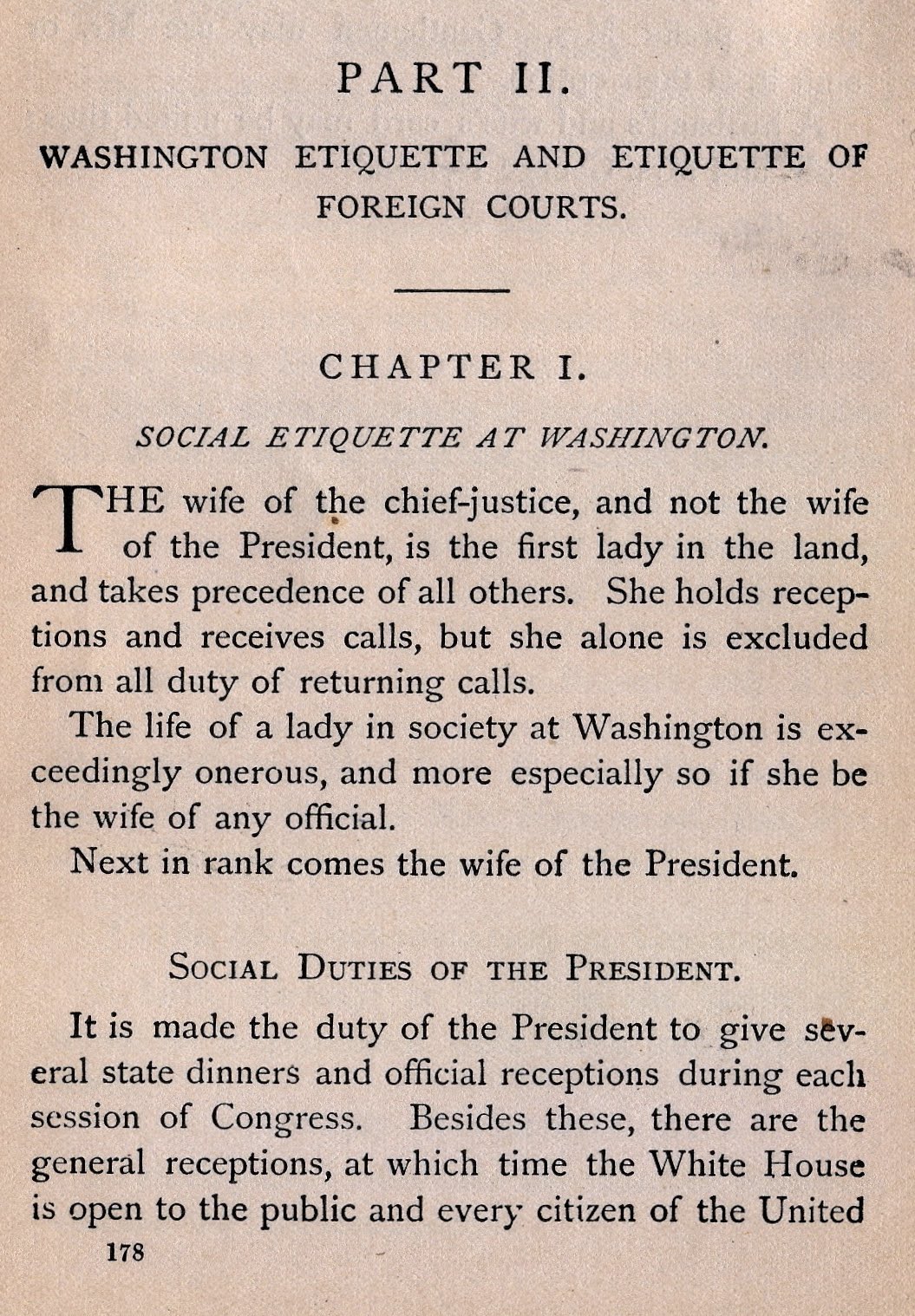
Just one example of what etiquette authorities were saying regarding Washington and wives of the President-


Duffey on Washingtonian Etiquette-

PART II.
WASHINGTON ETIQUETTE AND ETIQUETTE OF FOREIGN COURTS.
CHAPTER I. SOCIAL ETIQUETTE AT WASHINGTON.

The wife of the chief-justice, and not the wife of the President, is the first lady in the land, and takes precedence of all others. She holds receptions and receives calls, but she alone is excluded from all duty of returning calls.
The life of a lady in society at Washington is exceedingly onerous, and more especially so if she be the wife of any official. Next in rank comes the wife of the President.

SOCIAL DUTIES OF THE PRESIDENT.
It is made the duty of the President to give several state dinners and official receptions during each session of Congress. Besides these, there are the general receptions, at which time the White House is open to the public and every citizen of the United States has a recognized right to pay his respects to the President.

PRESIDENTIAL RECEPTIONS.
On the days of the regular " levees " the doors of the White House are thrown open, and the world is indiscriminately invited to enter them. No " court "-dress is required to make one presentable at this republican court, but every one dresses according to his or her own means, taste or fancy. The fashionable carriage- or walking-dress is seen side by side with the uncouth homespun and homemade of the backwoodsman and his wife.

Michelle Obama isn't the First Lady?


All About the firs
t, yet somehow forgotten, First Ladies of Washington D.C. Society-


Well, Martha Washington wasn't really the first "First Lady". No other former Presidents' wives were either. Now before you get upset with me, this is not a political statement. It is simply a statement for historical reference.

I applaud the wives of our Presidents. They do wonderful work for the people of our country. They are to be commended for simply helping their spouses through the grueling hours and painful intrusions into their most private lives. However, the First Lady (an honorary title, by the way) was always the spouse of the Chief Justice of the Supreme Court, as those on the Supreme Court have their jobs until they die, or retire, if they so choose. They are the only such lifetime jobs our government offers. The Presidency was, and still is, simply a "temp job".

Writers of etiquette books, and those in Washington society, were horrified in 1877 when journalist Mary C. Ames referred to Lucy Webb Hayes as "the First Lady of the Land". Prior to Ms. Ames pilfering the "First Lady" title for her article, no references to wives of the President were anything but just that; The wife of the President. Aside from the fact that Washingtonian etiquette prescribed the social duties involved in being a First Lady at that time, and the Supreme Court Justices wives took their duties very seriously, many wives of Presidents were not all too happy that their husbands were running for the office. Some wives were very content to stay in their homes, close by to their friends, and they did not wish to pull up stakes for a move to Washington.

Take Anna Harrison for example. She was 66 years old when her husband William Henry Harrison was elected President. She loved her home was not too keen on moving. She had bore many children, and six had died over the years prior to her husband winning the Presidency. She had no political or social agenda, or desires. She is often quoted as saying, "I wish that my husband's friends had left him where he is, happy and contented in retirement." She skipped the festivities in Washington after her husband's win, and decided to wait until after his inauguration to move to Washington. She missed his record breaking inaugural speech in the freezing Washington air. Six weeks into his term, Harrison died from pneumonia and pleurisy. Anna received the news as she was packing to move to Washington D.C.

Nowadays, I wonder how the original First Ladies, those "Forgotten First Ladies" of Washington if you will, would react to the title being even more corrupted to include titles like "The First Dude", "The First Dog", "The First Cat", etc... Probably with the same amount of mild horror, amusement and confusion that celebrities must feel when saddled with other media generated titles like Wacko-Jacko, The Governator, Bennifer, Brangelina, or ScarJo.
One last note on the subject...
A favorite of my reference books is an etiquette book written by Eleanor Roosevelt, and I will post some snippets of that book here at a later date. You can read Duffy's 1877 book on etiquette at Google Books for more insight into Washingtonian etiquette.

Why Are They Called 'Mess Halls' & 'Mess Kits' in the Military?

My husband, Cliff C. Graber, in the U.S. Army 82nd Airborne Division, messing around with a paper airplane and a few of his buddies.

Messing Around with Terminology


When referencing food and the military, I am frequently asked the same questions by students. “Why does the military give out mess kits?”, and “Why is the place where soldiers eat called a mess hall?” I am a person who needs answers that add up. Inquisitive kids are that way too. 

When I first started looking around for an answer back in the early 1990s, I found a few bits and pieces of information available, but not one source I read actually tied it all together to where it made sense to me. 

From the outset “mess” obviously meant “food” and nothing more. The biblical Essau had a “mess of potage” which is believed to be a portion of lentil soup or beans. While growing up my brothers had G I Joe action figures that came with “mess kits” and watching the “Beverly Hillbillies” on television I heard the term “mess a’vittles” frequently used. While listening to former Presidential aide Dee Dee Meyers talking on late night t.v. she referred to her “mess bill” for something she had eaten on Air Force One. It was starting to drive me a bit nuts. If “mess” historically had meant food, how, why and when did it become the definitive term for a state of confusion and disorderliness? 

It took me much sleuthing, but I finally found a very old book on word origins and voila…  there was an answer that made sense. The change in the general public’s definition of the word apparently was in the 1590s, when a party game called “Muss” spread across Europe. Muss was a game in which trinkets were tossed around a room and the party guests would scramble to retrieve them (anyone for some 52 pickup?)   As popularity of the game spread throughout Europe, with its various languages, the name of the game somehow was changed to “Mess”.   The Bible, military handbooks, and all other writings had naturally been left with the original meaning of the word intact. But from that point on, “muss” has rarely been used as a common term for something in a state of disarray, other than regionally in a few parts of the world. 

Many southern states here in the U.S. are one such regional area.   The term muss is still used in the south, while I rarely hear it here in Southern California.  The eyes of an octogenarian attending one of my seminars became misty as he recounted how his grandmother in Alabama would scold him for wearing his hat in her home. “I would say that my hair was a mess underneath my hat. She would then correct me by saying, ‘Your hair is mussed. It is not a mess!” 

Now I always try to remember that my daughter’s room is not a mess.  Her room is simply mussed up. It sounds better and somehow makes me feel a bit better about it.


This was originally posted in 2010

© Maura J. Graber 2010/The R.S.V.P. Institute of Etiquette

Expected Etiquette from the Late 1800's to the Mid-1900's


I can't seem to get enough old magazines and etiquette books.
It doesn't matter where they are from. I even peruse old books on sociology, ethnography, anthropology, psychology and history. They are windows into the past beliefs, ideas, hopes and culture that have shaped our society all around the globe today. In the future, I will be posting more of these nuggets I have snipped from some of my favorite books in my library. Good manners have always been a must for societies to thrive in peace, but the Victorian Era titans of industry, or
the faux aristocracy, seemed to step it up a notch with their on one-upmanship here in the U.S.


When my daughter and her boyfriend go to a movie, are introductions done properly?
Are my son's manners on dates anything like the date in the illustration from a book published in 1937?

Food for thought....

Featured Post

“What Have We Here?” is Here!

What Have We Here? The Etiquette and Essentials of Lives Once Lived, from the Georgian Era through the Gilded Age and Beyond.. . I have spok...