Etiquette and “Women’s Lib”


Back in my early teen years, the Women’s Liberation Movement was in full swing, Television comedies starring spunky, single women tackling the balance of life and romance in the big city, were all the rage: “That Girl,” “The Mary Tyler Moore Show,” “Rhoda,” etc… Then there were the shows like “Maude,” and a spinoff show, “Good Times” featuring witty, comedic banter with stronger and more vocal female leads, who tackled issues like abortion, single parenthood, widowhood and the Women’s Liberation movement. Just recently I purchased a 1971 copy of “The Cosmo Girl’s Guide to the New Etiquette,” which tackles not just etiquette, but etiquette and sexuality and the Women’s Lib Movement.


I don’t remember this purple pussy cat being some sort of logo for Cosmopolitan Magazine in the late 1960’s or early 1970’s or the Women’s Liberation Movement, for that matter. But it appears it was, as it’s in the front of “The Cosmo Girl’s Guide to the New Etiquette” book, and has a whole page to itself. What I do remember about the Women’s Lib movement was the bra burning, which I never really understood. I guess it was supposed to be symbolic, but burning images of the Playboy Bunny logo may have been more effective than burning something that I have found, overall, to be very supportive throughout my life. 

I also remember by the early 1980’s, thinking that many of the women the liberation movement was supposed to be helping to “set free,” seemed very unhappy and truly confused. These women, most 10 to 12 years older than me, were out in the world expressing every thought in their heads and jumping into some questionable beds. They certainly didn’t seem fulfilled in any way and sounded downright inauthentic when sharing their “wildly exciting” exploits. I can’t help but think they may have been happier if they had taken seriously some of the advice at the end of this particular chapter of the Cosmo Girls’ book. It was clearly promoting a social movement, but they may have found the support groups helpful. 

In fact, today’s social movements could use a few etiquette books with similar etiquette tips like these offered in 1971 below. At least these tips offer a way out of conversations one finds uncomfortable in, “Meeting once a week, week after week, in consciousness-raising is a kind of group therapy– free. You discuss what it means to you to be a woman... what it means in our society. . . what is gender.. what should it be? You share emotional experiences…” and my favorite bit of advice, “If you don't dig it, just stop going,” as opposed to succumbing to mobs screaming you down, or outright canceling you or someone else, for not agreeing with their beliefs: 

From “The Cosmo Girl’s Guide to the New Etiquette,” 1971, Coexisting with Women’s Lib and Good Manners
Coexistence with our militant sisters takes intelligence and tact. You cannot stem the tide of Women's Revolution (should you indeed want to) with insult... naiveté- “It's all too much for my fragile brain” or praise that damns- “Well, I certainly am for equal pay and child care centers, but I wouldn't be caught dead without my bra. . . . What are all these Lesbians up to?”

The Women's Liberation movement is many-splendored, multi splintered, and worthy of sincere attention. Even if you think the general idea is totally outrageous, you cannot defend your position in ignorance. And, like sex and politics. . . the Women's Lib debate is impossible to avoid.

If you don't know much . . . say, “I just don't know.. Tell me what you mean.” And then listen . . . really listen. “Are you willing to be nothing but a sex object?” you may be asked.

“I love being a sex object,” you might reply. “And my husband is a sex object too, and so is Robert Redford. . . . Gender is wonderful. . . but I hope and assume we are more than mere sex objects.”

An ideal way to learn more about the movement is to join a consciousness-raising group, or form your own, and subscribe to some activist publications. Try “Up from Under” and “Liberation.”…  Read a few books: a must is, “Sexual Politics by Kate Millett.”

Meeting once a week, week after week, in consciousness-raising is a kind of group therapy– free. You discuss what it means to you to be a woman... what it means in our society. . . what is gender.. what should it be? You share emotional experiences. Not only do you learn what your sisters are thinking, but you gain friends, identity, kinship, and possibly some surprising insights into your own head. If you don't dig it, just stop going. 

Informal Place Settings are Most Common


“A few of the people you'll meet at every party. It will pay you to get along with them.” — It will also pay to know their names and primary uses so that you can easily “read” your place settings at luncheons and dinner parties. 
Know your spoons– Placing a superfluous teaspoon at a formal dinner setting, is one of the biggest and common mistakes people make when setting the table. Teaspoons, with accompanying cups and saucers, are only found at informal lunch settings, tea settings or breakfast settings. If there is a teaspoon at your place setting, there must be a course for it; a fruit cup or appetizer, a palate cleanser, etc…
If a soup spoon is at the formal place setting, then a soup should be on the menu. And if there is a soup spoon, it should fit the soup type; Bouillon spoons only go with bouillon cups or bowls, cream soup spoons are only placed at settings with low, soup “plates,” etc…
Informal Place Setting Diagram —Only a luncheon or a very informal dinner setting will feature a cup, saucer and teaspoon. At formal dinner parties, coffee or tea are served away from the dining table. The service for coffee, tea or after dinner liqueurs, is brought out after the meal and usually served away from the table.


Eating is the one social activity common to everyone around the globe, but eating and dining are two different things. Practice dining when you are not in public and it will help you to avoid merely eating when among others.
“Table manners grew out of the fact that unless he is eating in a room empty of all but himself, a man eats in company and food is less appetizing if the other fellow's table manners are sloppy and disgusting. It matters little what sort of food is being served, whether the table is loaded with priceless silver and china or tin and graniteware; the simplest meal is made more attractive by the use of good table etiquette.”— From “Manners for Moderns,” 1938


Part of this article was previously published on the Etiquipedia.blogspot
Etiquette Enthusiast, Maura J. Graber, is the Site Editor for the Etiquipedia© Etiquette Encyclopedia


Pea Knife Etiquette and History

 More from
“What Have We Here? The Etiquette and Essentials of Lives Once Lived from the Georgia Era through the Gilded Age and Beyond…
A most popular food with which to show off one’s knife dining skills was peas. Many people practiced lining peas carefully upon a steel knife blade, to “pour” into their mouths, much to the chagrin of spouses and parents. A few uncouth, but industrious people even invented and designed special, “pea knives.” It took, as gentle reminders, repeated news and magazine articles over the years to finally get the practice all but abandoned. – The Smart Set, 1921


An unused pea-knife photo and two unused articles, which were originally chosen for my new book. I thought I would share them here, as knife-eating was much more common in the 1700’s and 1800’s than most people understand. Peas were a staple of many diets, as was pea-flour. Two-tined forks were difficult to pick peas up with, so knife blades, which were wide and flat, with dull blades, made the perfect utensil for many to convey peas to the mouth. Back in the 1960’s, when I would go visit my grandparents, my grandfather used to entertain me by eating his peas from his knife. I found it tremendously funny, and he was quite good at it, but it annoyed my grandmother to no end! 

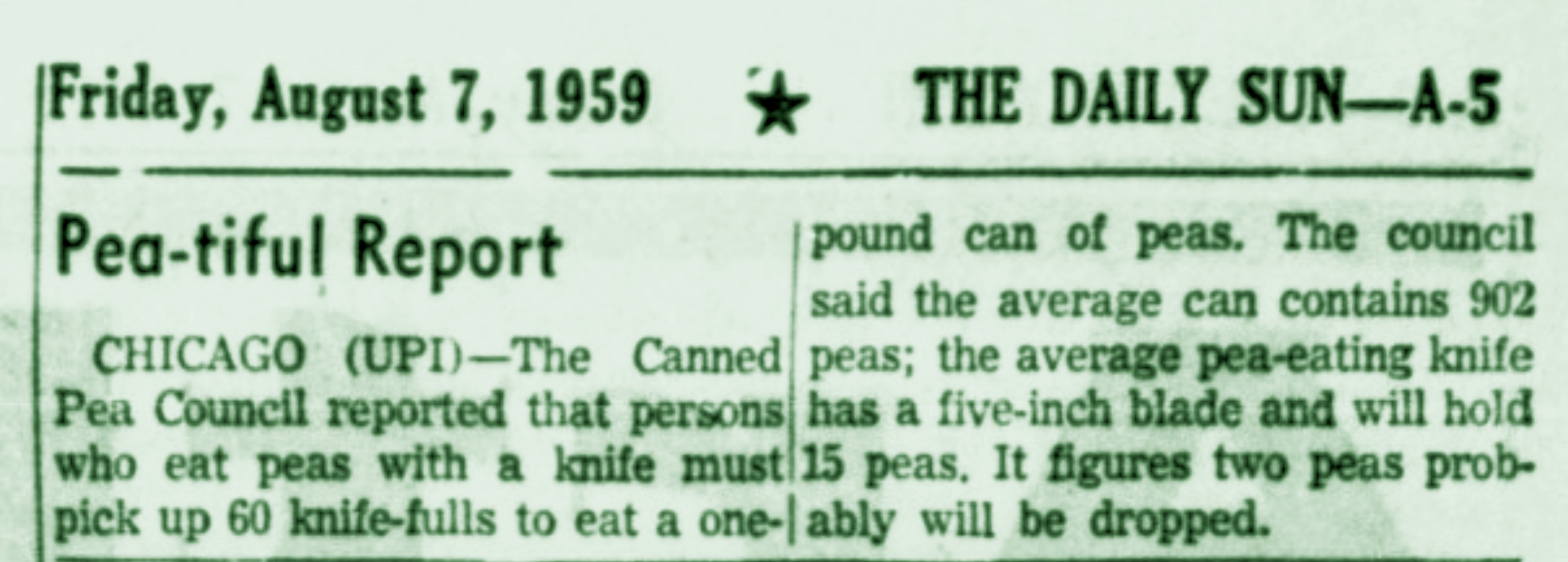
Friday, August 7, 1959 – The Daily Sun -A-5 – Pea-tiful Report

CHICAGO (UPI)-The Canned Pea Council reported that persons who eat peas with a knife must pick up 60 knife-fulls to eat a one-pound can of peas. The council said the average can contains 902 peas; the average pea-eating knife has a five-inch blade and will hold 15 peas. It figures two peas probably will be dropped.


Dining with Dignity –
Dear Sir: I have been troubled with palsy and find it very hard to get a good knifeful of peas up to my mouth. I was compelled to use a spoon, but somehow they don't taste the same. I saw your advertisement in the Echo and I bought a safety pea knife and I want to tell you it's solid comfort. I can't shake them off. God bless you. John Applegate.-From a Vermont paper, 1927


A page from the book, 

What Have We Here?: The Etiquette and Essentials of Lives Once Lived, from the Georgian Era through the Gilded Age and Beyond...


Some History of Etiquette from 1901

The article below was written nearly a century and a quarter ago. Reading this, one has to wonder what people will think of our etiquette a century and a quarter from now!


Etiquette is a form of fashion more important than style in dress, for the reason that the varying codes of manners have influenced morals, something changing the cut of a coat cannot be said to have done. When etiquette demanded that a gentleman accept a challenge or acknowledge himself a coward in the minds of his fellow citizens, it encroached sharply upon ethics. Now that it has gone out of fashion to kill, gentlemen find small difficulty in keeping the sixth commandment. The less formal etiquette becomes, the less wanton taking of life there is among those who consider good breeding of consequence. 

As the civilized race now stands, either man or woman can be refined, regardless of shape of hat he or she wears. This was true in any century, but 200 years ago and back of that period a gentleman and lady could, according to approved etiquette, gobble food with their hands from a common dish set in the center of the dining table and filled with the entire fashionable bill of fare prepared for the occasion. Gratefully we now acknowledge such proceedings to he “bad form” and in so doing pronounce ourselves two centuries removed from the table manners of swine and one point away from that brute, no matter how similar to him our turn of mind may remain in some other respects.–National Magazine, 1901

Gilded Age Dinner Host’s Duties

Above- Two gilded age or late 19th century, sterling silver, Saratoga Chip servers – One with a plain sterling bowl and the other with a gilded bowl to protect the silver from the salty potato chips.
§§§§§§§§§§§§§§§§§§§§§§§§§§§§§§§§§
 Gilded silver, also called “silver gilt,” or “parcel gilt,” or “vermeil,” is a thin layer of gold on silver to beautify the flatware, or whatever the item may be, but more importantly, in my opinion, it is to protect the silver from corrosive elements it may encounter. Salt is extremely corrosive, as is citric acid or other acidic foods or beverages.

To perform faultlessly the honors of the table is one of the most difficult things in society; it might indeed be asserted, without much fear of contradiction, that no man has as yet ever reached exact propriety in his office as host. 

When he receives others, 

  • He must be content to forget himself; 
  • He must relinquish all desire to shine, and even all attempts to please his guests by conversation, and rather do all in his power to let them please one another.  
  • Help ladies with a due appreciation of their delicacy, moderation, and fastidiousness of their appetites; and 
  • Do not overload the plate of any person you serve.  
  • Never pour gravy on a plate without permission.  It spoils the meat for some persons. 
  • Do not insist upon your guests partaking of particular dishes; 
  • Never ask persons more than once, and never put anything by force upon their plates. It is extremely ill-bred, though extremely common, to press one to eat of anything. 
  • The host should never recommend or eulogize any particular dish; his guests will take it for granted that anything found at his table is excellent. 
  • The most important maxim in hospitality is to leave every one to his own choice and enjoyment, and to free him from an ever-present sense of being entertained.  
  • You should never send away your own plate until all your guests have finished. - From Samuel Wells’, “How to Behave,” 1887

Gilded Age Settings and Oysters

A Gilded Age, 6 course, formal place setting, set for oysters as the first course.

As “What Have We Here?” at 162 pages, is 4 times longer than “Reaching for the Right Fork,” I could not use every photograph I took for the book. It would be too long. I will therefore be occasionally adding some of the photos which were ultimately unused to my blog posts. Here is one above, showing a Gilded Age formal place setting, set for a first course of oysters. 

Oyster forks, or any cocktail forks, can be properly placed in 3 different ways:
  1. As the first of 3 forks to the left of a setting.
  2. At the far right of a place setting, laying flat on the table next to the soup spoon or first knife, whichever utensil to be used afterward.
  3. Or resting at an angle, with the small tines resting in the bowl of the soup spoon.
In the setting above, the oyster fork rests at an angle in the soup spoon, or the 3rd option. This positioning was to help those dining at crowded Gilded Age tables deal with an ever-growing list of specialty utensils at each place setting. The fork on the far left of one setting could be mistaken for the first fork expected for many foods for the diner on the right. 

At the same time, the decision had just recently been made by the arbiters of good taste during that time period in the U.S., to no longer allow four forks on the left, but to limit them to three. Those not up to snuff on the most recent etiquette rules, whether hosting a dinner or as a guest at one, could be confused. Laying it at an angle with the tines resting in one’s soup spoon bowl, alerted that guest that the fork belonged to him or her and not the place setting to the right.

This below is a page from the book, “What Have We Here?”: The Etiquette and Essentials of Lives Once Lived, from the Georgian Era through the Gilded Age and Beyond...


“What Have We Here?” is Here!


I have spoken about writing this book for the last few years, and finally the book is now here, available on Amazon. It was a labor of love and I enjoyed every moment of photographing the items I carefully chose to write about, many of which are on the front cover. 

There is a lot of information on Gilded Age etiquette (in anticipation of the upcoming Julian Fellowes’ program now filming for HBO in New York 😉) along with Georgian Era and Regency Era etiquette, etc… The crazy thing is that it took me several weeks to receive my author copies, but during my wait, people around the world were posting the most wonderful reviews on Instagram! Especially in Italy, where I have made several new friends.  

Of course there are plenty of utensils in the book. Favorites are Edwardian era cayenne pepper spoons, like this sterling one example below, from 1905.
Gilded Age chocolate spoons with a chocolate muddler, demitasse-sized trembleuse and pots de creme cups.
Many other items which are not utensils, but were part of everyday lives, are shown coming from the 1700’s through the early 1900’s. And, of course, there is a lot of etiquette included throughout, including place settings and proper use of glasses and dishes.
The Graber Olive House and beautiful late Spring weather offered a perfect backdrop for much of my photography.
Etiquette for gloves and glove stretchers like this Bailey, Banks and Biddle, sterling silver glove stretcher in the form of a duck, is one of my favorite items. Gloves and glove etiquette figure prominently in the book. And the section on napkins and gloves in the Gilded Age with the appropriately named, “napkin burrito,” is a must read and see!
.
I want to thank all of the readers who have already purchased the book. Your incredible reviews online and Instagram have meant more than you know and make what I do all the more worthwhile!


I’ll Be Back Soon

I will be back soon! In the meantime, you can read all sorts of ad-free etiquette and etiquette related articles, curated by me, on the Etiquipedia Etiquette Encyclopedia 


The Graber Olive House in Ontario California is still closed, due to Coronavirus concerns. We are sorry we cannot offer our Etiquette Seminars or Classes at this time. For Online Zoom Classes, please email us at RsvpInstitute@gmail.com

Etiquette and Agony Aunt Advice

“Once upon a time two women went room hunting in a lodging house at a certain summer resort...” Not these two, but two others. – Ruth Cameron was a no-nonsense, “Agony Aunt” who had and advice column called “The Morning Chit-Chat” in early 20th century newspapers.

Sensitiveness May Be Cowardice

ONCE upon a time two women went room hunting in a lodging house at a certain summer resort. At one house they were shown a very pleasant room, neat, attractive, well furnished and fairly reasonable in price, and the woman for whom the search was being conducted seemed almost persuaded. “I like this room immensely.” she said to the hostess, who had been unusually agreeable and courteous in showing the room. “I am almost sure I will take it, but I must consult my husband. I’ll let you know by Thursday.” 

That was Tuesday. On Wednesday another house hunter came to this house and fairly fell in love with the room in question. She was told that another party had the refusal of it. She urged the hostess not to mind that. “If you will only let me have the room, I'll take it today for the whole summer,” she promised. But the hostess, being new at the business, and having an unusual sense of honor, said she must wait until she heard from the other party. Whereupon the applicant, not being in a position to wait, went elsewhere. That was two months ago. The woman who had the refusal of the room has not telephoned yet. Needless to say, she never meant to. Indeed, she was scarcely out of earshot before she confided to her companion: “I knew that room wouldn’t be big enough, but she was so pleasant that I didn’t want to tell her that. I am so sensitive.”

“But won't you hate to telephone?” inquired the companion. “Oh, my dear, I shan’t telephone her. If she doesn’t hear by Thursday, she’ll know I’m not coming. I wish I wasn’t so sensitive (with a smile that showed how proud she was of just that), but I simply can’t bear to hurt people’s feelings.” Do you know what that woman reminds me of? Of the kind of folks who are so sensitive that they can't bear to chloroform or otherwise dispose of their pet cats, but are quite willing to leave the poor creatures to shift for themselves and probably be killed by dogs or die of starvation or rabies. 

You don’t see the parallel between the two? I do. They both display that peculiar kind of tenderheartedness which makes its possessor cruel instead of kind. Do you know whose feelings that woman was really afraid of hurting? Simply her own. She didn't want to make the effort of saying a firm, decided “No,” so she shiftlessly slid out of the situation in that cowardly way. When the fear of hurting anyone’s feelings makes you deceitful and blind to their best interests, you may be pretty sure that it’s your own feelings that you are really guarding. 

Suppose a surgeon should look at a mortifying finger and say, “I know I ought to cut that off, because, if I don’t, the trouble will spread to the whole arm, but I can't bear to hurt the patient.” Suppose a doctor should say, “I know that’s the only medicine that will cure the patient, but it’s so bitter I hate to ask him to take it.” The tenderneartedness that is straightforward, honest and cruel to be kind, if necessary, is certainly a virtue, but the sentimental, deceitful tenderheartedness that is kind, and thereby cruel, is very much nearer a vice. — By Ruth Cameron, 1912 

New Etiquette Classes for Teens


Our newest etiquette classes for teens begin at 6:45 p.m. on July 2nd at the Graber Olive House in Ontario. Call 909-923-5650 for more information or stop by the Graber Olive House to fill out a registration form.

Featured Post

“What Have We Here?” is Here!

What Have We Here? The Etiquette and Essentials of Lives Once Lived, from the Georgian Era through the Gilded Age and Beyond.. . I have spok...